Challenge Accepted: Teaching patterns
Yes, it takes a while, but you do get there eventually, and that’s part of the point.
From one perspective, there’s only one challenge in any given game, and that’s the last sequence. Every other portion is just there as training.
Obviously, the goal from a design standpoint is to have all of those intermediary challenges be just as fun. But they’re also there to train you for the final things, the real events, the big time. It’s the reason why games don’t start with the final boss fight, because you need to learn all of the elements that go into that fight. The first level in Super Mario Bros. introduces most of the major elements you’ll deal with through the game, and it does so in an environment wherein you can fairly easily learn how they work.
Every game is different, however, and there are lots of ways to teach players how to do things. So how do you teach players how to do the things they’ll have to do at the end of the game while still making the beginning of the game fun to play?
The Final Fantasy Project: Final Fantasy IV: The After Years, part 1
Artwork from a sketch by Yoshitaka Amano
So, let’s recap briefly. Long after the original Final Fantasy IV release, Square decides to greenlight a remake of the game for the DS. Seems straightforward enough. But someone had an idea that tied into an experiment with episodic gaming. What if there was a sequel, one that told a new story altogether? What if players could download new installments as they came out, picking out individual episodes or watching the whole thing unfold at once? What then?
Well, we don’t have to wonder; that’s what happened. A new story was written, new characters created, and the episodes began coming out. So here we are with the PSP version, which collections all of them into a single packaged form. I mentioned back when I started the interquel between the two that I quite like the fact that rather than a straight sequel, this one puts quite a bit of distance between the events of the original and the events of the sequel; they’re connected by world and by several characters, but not by conflict.
A helpful guide to Western and Eastern RPGs

This game tries to trick you into thinking it’s one thing and then it becomes something else. Surprise!
As you have probably been able to ascertain from the fact that I have an entire series of columns on this very site dubbed “The Final Fantasy Project,” I have a bit of a thing for RPGs. They’re fun! And I’ve played a lot of them over the years, some of them from the Land of the Rising Sun, others from the Land of the Rapidly Diminishing Water Supply (better known as “California”). Or the Land of the Snows and Hockey (Vancouver?). The point is, there are two different distinct design systems at work when it comes to computer RPGs, that’s what I’m getting at.
Pop culture being what it is, of course these two philosophies have to be at war with one another, and you are expected to have passionate points of view on the matter about which one is better. But some of you might not have time to carefully play through earlier installments of beloved franchises to pick out which one is better, and quite frankly no one should ever be forced to play through several portions of the Ultima series or the Fire Emblem series without the promise of a paycheck. Thus, I’ve assembled a quick guide to both sides, helpfully explaining what these things are with an eye toward pissing everyone off equally.
Demo Driver 8: BeatBlasters III
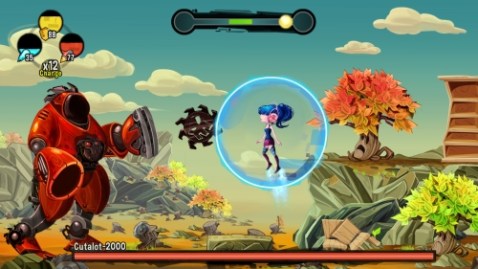
I am relatively sure that this is the place where Kirby bosses are born.
Sometimes games wind up with poor scores simply because no one can really categorize them, even if they want to. BeatBlasters III is kind of terrible at basically everything it appears to be, and it’s only when you start to get a feel for what it actually is that the game goes from being “bad” to “fun.” Although I freely admit that not everyone is going to feel even remotely the same way as I do about the title.
See, BeatBlasters III is not a platform game, although at a glance it sure looks like one. There are platforms and you move between them, but that is hardly the point. Nor is it a rhythm game, although there is a rhythm element to the game. It’s some very odd combination of both, and yet it manages to be neither, or at least not with any skill. It’s a game with poor play control that’s part of the experience while at the same time being a game with perfect control for creating exactly the right sort of tension.
Perhaps I should start from the beginning.
Lest a monster you become

It’s not the supernatural that makes any hint of opposition something to be destroyed.
What really locked in my opinion of Vampire: The Masquerade – Bloodlines was Heather.
Heather is almost the definition of an optional character, albeit an important one. You first find her when she’s in a hospital bed barely clinging to life, obviously going to die unless you do something. Feeding her a drop of your vitae will ensure that she lives, and if you’re trying to be a halfway decent person you’ll do it without a second thought. It’s an altruistic act, a kind one, something wholly divorced from your own needs.
It’s only when she shows up again that you realize what you’ve done, but even then you can’t really object. Heather immediately sets about making herself useful to you, and it’s easy to keep being nice to her right off. After all, she makes it clear that she can help you when you’re otherwise asleep, and she doesn’t want anything in return except to be near you. You could run her off, but this happy fashion student just wants to be near you. Why would you be so cruel?
Then some time passes, and she tells you she’s dropping out of school after you’ve further bound her to your blood. And you realize that you’ve ruined her life.
 Recent Work
- An error has occurred; the feed is probably down. Try again later.
Chocobo Dash
- An error has occurred; the feed is probably down. Try again later.
 Eliot Lefebvre