What’s a success?

I wanted to come here when it was peaceful. Mission accomplished.
I woke up this morning to a hug from my wife, and it was lovely. Is that success?
While I don’t talk about it a lot here, I spend a lot of time thinking about what I’m doing, what projects I’m pursing, and generally raking myself over the coals for where I am in life as a grown adult. I look at what I’ve accomplished and I feel like I could have done more, that I could be further along than I am right now. Then I look at where I am and wonder if I’m further along than I tend to believe that I am. Then, usually, I pet the cat.
Success or failure is a big deal in basically every industry. We judged whether a game or a movie or an album has succeeded or failed. The problem isn’t that we do that, it makes sense, there’s a good reasoning behind it. And yet at the same time there’s a real challenge in any industry judging success or failure, because there’s so much more going on than the obvious metrics, and those metrics are lying bastards.
Mangling terms

Sometimes, admittedly, it’s not necessary to call a game a clone to get an idea of how it plays.
Remember when “clone” wasn’t a term of scorn when discussing a video game?
When people first started saying thing like “Saints Row is a clone of Grand Theft Auto III,” it was actually conveying useful information. Considering the sheer number of games available and the tendency for a new game to closely emulate previous games with a few changes, “X-clone” can often be more descriptive than a simple genre listing. Sure, both New Super Mario Bros. and Sonic the Hedgehog 4 are side-scrolling platformers, but saying that a game is a clone of New Super Mario Bros. provides far more relevant information about how the game plays.
Not that it matters any more, because if you call something a clone of another game, the implication is that it’s a bad game. Because calling things clones has fallen victim to an odd part of discussing games, where we as a culture somehow manage to create and then destroy the terminology we would use to discuss this stuff. It happens everywhere given time, but when it comes to game our new terminology seems to have a half-life of ten minutes before it becomes totally useless.
Hard Project: Half-Life
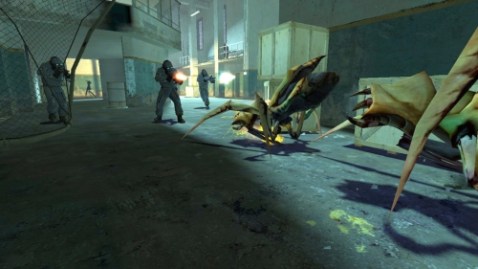
Defiant!
Half-Life is not one of the most voluminous franchises in existence. It consists of the original game, a smattering of expansions for that game, the sequel, and two-thirds of an episodic follow-up to that sequel. Oh, and a whole lot of talk, which puts me in the mind of paying money for an idea, but so long as there’s no Kickstarter my carefully cultivated rage gene doesn’t get activated by pretentious talk by people who cannot get a video game to launch.
Then again, I may be a little harder on Gaben & co. than they deserve. I’ll snark endlessly at the fact that it has taken seven years without so much as a peep about Half-Life 3, but when you think about it, it’s a hard project to start on. Not because of lack of money or licensing rights, but because the game has some pretty huge shoes to fill, and a whole lot of baggage that’s weight the hypothetical down.
Keep the lights on
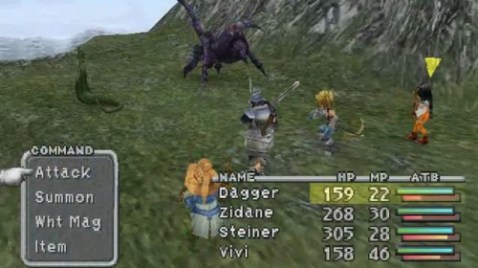
The light of the Crystal, great, but can we talk a little more about the light of the server’s power indicator?
When Final Fantasy IX first released, it had a whole companion website, PlayOnline. The site was an in-depth interactive walkthrough for the entire game, filled with database information, all the stuff you could possibly want from a site devoted to a single game. The site was also designed to work with people who had bought the strategy guide, which tied into parts of the website wherein players could enter codes and see additional tips and tricks about a given area of the game.
That was dumb all by itself. But it makes the owners of the strategy guide look even more silly now, because that walkthrough site is gone. It doesn’t exist any more. The URL is now devoted to Final Fantasy XI, after Square’s grand ideas about that service’s functionality fell through.
You might say that it’s irrelevant, and it certainly is. But it speaks to an issue with a lot of games that were launching around the same time that the century turned, and one of the features that gaming is still struggling to deal with. Everyone knows, of course, that online functionality is important. It’s also not free, and the graveyards are littered with the bones of functions that got torn away.
Tough acts to follow

So far I’ve been having a blast, and that’s usually my first goal with any game in the franchise, so mission accomplished.
The Sims 4 came out just a little while ago, and I like it. It’s had some stuff snipped from it and some other things added in; conversations feel a lot more organic, for one thing, and relationships are thankfully measured along two axes rather than one. It’s solid, in other words. But its biggest competitor is hanging over its head in the form of the third game in the franchise.
I’m not really interested in talking here about what features were removed for this incarnation of the game; by and large, the cuts feel like they were good removals considering what got more development as a result. But I found myself thinking how difficult a road the game has ahead of it based not upon its own merits but simply by virtue of being new. There’s no reason a new game with a new engine can match up to what a predecessor with five years of development has accomplished, and yet it has to do exactly that. It’s a tough act to follow.
 Recent Work
- An error has occurred; the feed is probably down. Try again later.
Chocobo Dash
- An error has occurred; the feed is probably down. Try again later.
 Eliot Lefebvre