Immersion isn’t a headset
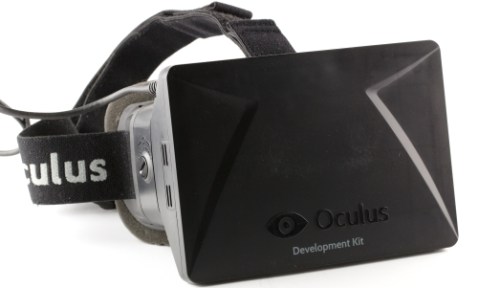
It’s hard to believe that this is the device that will change gaming forever, due in no small part to the fact that it likely won’t.
What a time it was to be alive in 1995! The Cold War was over, the dot com cycle was not too far away but far enough that we didn’t need to think about it yet, and we were all still pretending that strapping a monitor to your face was the future of gaming. It’s been nearly two decades, and now people are once again holding up the notion of VR headsets as a game changer that will totally alter the way we play games because it’s like you’re actually in the game now, guys!
These people are also baffled as to why everyone else doesn’t recognize the brilliance of these devices, which kind of seems like a self-defeating cycle.
I’m not saying that the Oculus Rift is going to fail; I don’t have a crystal ball, I can’t predict that. I don’t imagine it’s going to make the impression on release that everyone backing it seems to assume it will, however, and I think the reasons are pretty obvious. Yes, it’s very interesting to sit down and play a game with it, but there’s a lot more going on than just “is it pretty and 3D.”
Frozen and the art of unlearning

If you don’t like it, I’m not going to convince you otherwise, but I question your decisions.
I was born as a child of winter, in the midst of a blizzard. I feel it down to my bones, feel rime creep in around the corner of my eyes when I close them, feel my skin exult at the biting air that blows in when October starts to die and make way for November. When snow falls, I smile. The cold really never did bother me anyway.
That is not why I feel a connection to Frozen. But it certainly makes the film’s chill landscape feel that much more welcoming. A kingdom of ice and frost looks less like a lonely wasteland and more like a comfortable place to be, if not forever then at least for a time.
But the connection goes deeper than that, and it ties into the fact that both of the main characters in the film have such a profoundly personal journey that you kind of half to check yourself on occasion to remind you that is, at its heart, a film for children. The themes of the movie are a lot deeper than you’d expect, and for me – for a lot of people – this is a story detailing the same journey that adult life has already put us through, but with a great deal more compassion and acceptance than you’d think possible.
The fault of modern gaming is our own
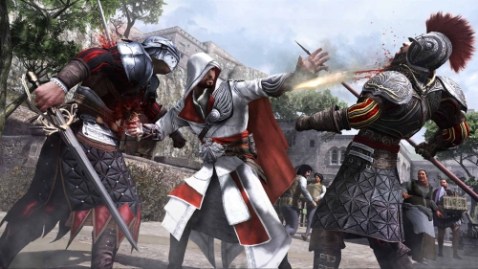
Taking a bold step of bringing in stubble-covered white guys, but this time they’re wearing hoods.
We’re in the wake of another year’s E3 when this is being published. Maybe you’re reading it after. Maybe you’re reading it at an E3 long after it’s been written. Maybe you’re even reading it during another convention, or just on an otherwise idle day when you’re thinking about the state of video games, wondering how it all turned out like this. How did we get to a landscape with all these generic shooters, with games that run longer and longer with less and less to say, how did we get to all of this?
Simply speaking: we asked for it.
I don’t mean that in a snide fashion, I mean that we, as gamers, asked for exactly what we got as modern gaming developed. Each part came down to us asking for something en masse, then deciding after we had it that we didn’t want it much to our detriment. And rather than blaming developers for doing what we asked, if you’re not happy about the state of games, it might be time to look at what we asked for and admit that really, this is what we said we wanted.
Our struggle to model a female character

We spent months figuring out how to make it look totally realistic when white guys run through dank sewers so that you can seriously feel the sweat and stench and now you want us to add girls to the mix? What are we supposed to do?
I know we’ve all gotten a lot of mileage out of making fun of Ubisoft lately, due to the fact that their reason for a lack of women in the new Assassin’s Creed game comes down to a simple difficulty in modeling ladies. It seems like a mockable standpoint, like a bunch of people trying to defend their complete unwillingness to do something with a poorly conceived cop-out that mostly shows a profound lack of care for the gender that makes up half of the gaming market.
Alas, while I’ve gotten my own jokes in, I suppose now is as good a time as any to reveal that I was on the team which tried to crack the modeling problem. Oh, certainly, it might seem silly to you, but as it turns out, women are a lot harder to put into games than you think. What follows, thus, is a completely accurate picture of the process wherein we tried and failed to add a single woman to the game as a playable character. Perhaps now we can finally put these matters to rest once and for all.
 Recent Work
- An error has occurred; the feed is probably down. Try again later.
Chocobo Dash
- An error has occurred; the feed is probably down. Try again later.
 Eliot Lefebvre