A helpful guide to Western and Eastern RPGs

This game tries to trick you into thinking it’s one thing and then it becomes something else. Surprise!
As you have probably been able to ascertain from the fact that I have an entire series of columns on this very site dubbed “The Final Fantasy Project,” I have a bit of a thing for RPGs. They’re fun! And I’ve played a lot of them over the years, some of them from the Land of the Rising Sun, others from the Land of the Rapidly Diminishing Water Supply (better known as “California”). Or the Land of the Snows and Hockey (Vancouver?). The point is, there are two different distinct design systems at work when it comes to computer RPGs, that’s what I’m getting at.
Pop culture being what it is, of course these two philosophies have to be at war with one another, and you are expected to have passionate points of view on the matter about which one is better. But some of you might not have time to carefully play through earlier installments of beloved franchises to pick out which one is better, and quite frankly no one should ever be forced to play through several portions of the Ultima series or the Fire Emblem series without the promise of a paycheck. Thus, I’ve assembled a quick guide to both sides, helpfully explaining what these things are with an eye toward pissing everyone off equally.
Demo Driver 8: BeatBlasters III
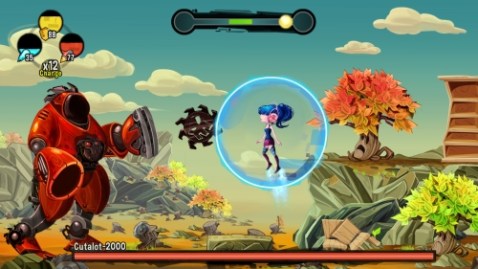
I am relatively sure that this is the place where Kirby bosses are born.
Sometimes games wind up with poor scores simply because no one can really categorize them, even if they want to. BeatBlasters III is kind of terrible at basically everything it appears to be, and it’s only when you start to get a feel for what it actually is that the game goes from being “bad” to “fun.” Although I freely admit that not everyone is going to feel even remotely the same way as I do about the title.
See, BeatBlasters III is not a platform game, although at a glance it sure looks like one. There are platforms and you move between them, but that is hardly the point. Nor is it a rhythm game, although there is a rhythm element to the game. It’s some very odd combination of both, and yet it manages to be neither, or at least not with any skill. It’s a game with poor play control that’s part of the experience while at the same time being a game with perfect control for creating exactly the right sort of tension.
Perhaps I should start from the beginning.
I would be thankful

If you’re in America, like me, you’re eating one of these today.
For a couple of years, I had a regular column that inevitably ran on Thanksgiving. Never one to pass up an opportunity for an easy gag that tickled my fancy, the joke was that every single year saw me wishing readers a happy every-holiday-other-than-this-one. I didn’t have enough time to eventually move into St. Swithin’s Day, but given enough time I am certain that would have happened. I can, in fact, be dreadfully predictable every so often.
This year, I do not have that duty. Instead, I’m sitting here and thinking of the many things I do have to be thankful for this year – a successful first year of marriage, the excellent reception I’ve gotten for this project thus far, Final Fantasy XIV, Defender’s Quest, BoJack Horseman – along with the many things that I can’t be thankful for because they aren’t, strictly speaking, real. They should be real. I think all of them are pretty self-evident, inevitable, and we’ll be happy when they come around. But the sooner these things pass into the desert of the real, well, the more thankful I’ll be.
Hard Project: Dungeons & Dragons

Taking on Tieflings as a basic race was probably a wise move, but it also speaks to that back-and-forth process of taking something, making it non-generic, and then trying to make it generic again.
When Gygax and Arneson first came up with Dungeons & Dragons, it seemed to be half for a lark. Cue years of discussion, back and forth, debates about the nature of roleplaying, the inclusion of computers, debates about the nature of what makes a computer game a proper RPG or not, and so forth. Amidst all of that, the franchise has steamrolled on, and let’s be fair, we’ve gotten some pretty great games set in one of the many Dungeons & Dragons settings over the years.
We’ve also had some horrible ones. And quite frankly, they’re hard to get right no matter what you do.
Part of the problem is that Dungeons & Dragons doesn’t quite have a mythos so much as it has disconnected setting elements rammed together in order to make tabletop games work. But I don’t think there’s ever a way to make that title into an easy project, despite the good games that have come out of it. For a lot of good reasons.
 Recent Work
- An error has occurred; the feed is probably down. Try again later.
Chocobo Dash
- An error has occurred; the feed is probably down. Try again later.
 Eliot Lefebvre