Telling Stories: No repeats

There are times and places where repeats are perfectly fine. A lot of radio stations in Connecticut seem to advertise “no repeats” as a badge of honor, which is slightly less than heartening when you realize that these stations have perhaps ten worthwhile songs in their rotations. Nor do I expect most television shows to provide me with a constant drip of new entertainment year-round. Heck, half of my knowledge of Law & Order comes from catching enough out-of-order repeats that I eventually began to piece together a coherent whole.
Roleplaying is not a medium which is kind to repeats, however. I would go so far as to say that repeats are actively detrimental to roleplaying for a number of reasons. They’re tempting, at times, but in a medium which relies upon your ability to craft an entertaining story with other people, handing over a story people have already seen just feels like going through the motions for no real benefit.
The Final Fantasy Project: Final Fantasy IV: The After Years, part 4

Artwork from a sketch by Yoshitaka Amano
There’s no place like home for the holidays, with the acceptable caveat that “home” can mean a variety of things other than “at the home of your parents.” Sometimes your parents are pretty toxic people to be around. Which, not coincidentally, is the subject of this next installment in Final Fantasy IV: The After Years. Or at least it’s related. They occupy similar headspaces. Look, doing segues on December 24th is difficult, especially when you’re working very far ahead.
One of the things that I do wish was a bit more common in these little vignettes was more character study work. They’re quick and inconsequential, which is part of the point, and that’s all well and good. At the same time, it’d be nice to get inside the characters’ heads a little bit more. Most of the plot sequences are entirely given over to advancing the plot at a whipcrack pace, and the characters are all hurtling toward their destinations with little chance to bounce off of more than one or two other people. Sort of a missed opportunity.
Hard Project: Tech games
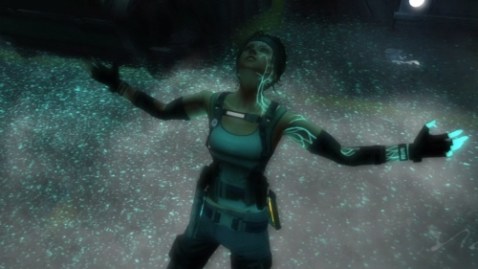
I can’t be too hard on a game that only set me back fifty cents, but still.
Hydrophobia: Prophecy is not a very good game overall, but it sure is an amazing tech demo for water physics. The way that water behaves in that game is absolutely amazing. It flows believably, moves your character around like water ought to, and generally serves as a clear indicator that the majority of work was on creating the best damn water simulation ever. Actual gameplay and stuff like that was a secondary concern at best. Which is fine; it joins a long list of tech games that aren’t very good.
Tech games are exactly what they sound like, demonstrations of technology that have a game wrapped around them. They are also almost universally terrible. In fact, there’s only one company out there which has managed to produce good tech games with any consistency – Nintendo. And there’s a good reason why, wince that ties into both why tech games are a hard project and why it’s so difficult for third-party developers to make a good game for a Nintendo console released in the past twenty-ish years.
Demo Driver 8: Gunpoint
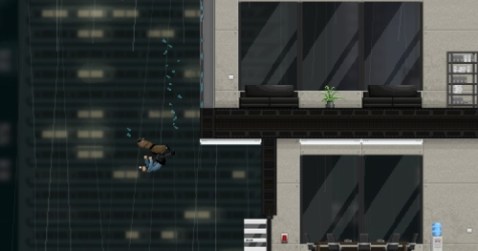
The Real Folk Blues.
Gunpoint is probably closer to a stealth game than a puzzle game, because it reminds me a lot of Mark of the Ninja. Despite the fact that it really doesn’t play like Mark of the Ninja at all.
According to its store page, Gunpoint is a stealth puzzler, but the emphasis is more on the former than the latter. I say this because stealth games are by definition puzzle games; you’re trying to figure out how to get from point A to point B without being caught, shot, or otherwise stopped. What makes for a particularly good stealth game is when the game gives you various tools to accomplish those central objectives, allowing you to go through the stages however you want.
It’s rare for a game to explicitly give you more puzzle-like control over the stage configuration, though, which makes up Gunpoint‘s central gimmick. And it’s a gimmick that works well, no more or less realistic than Watch_Dogs allowing you to hack everything with bizarre results but far more subtle and well-paced in how it plays out. Like Mark of the Ninja, you are a predator in the shadows, but instead of lurking in corners and executing elegant maneuvers, you’re a ghost in the machine.
Telling Stories: The post-mortem examination
When everything is said and done, that’s when you can take it all apart.
I recently wrapped up some pretty big roleplaying in Final Fantasy XIV. Well, “recently” more in the sense of “within the past month,” but that’s not the point. It was a big storyline with lots of moving parts, the near-death of the main character I’ve been playing for the past four years, and a lot of long-standing character threads finally getting resolved. Not that there aren’t still boatloads of story threads to be picked up, of course, and so as soon as it was over I started running a post-mortem on it.
So why do that instead of get started on the continuation of the story? Because a post-mortem, written or not, is a great way of examining how the whole event went down, even if it’s just from your perspective. The most effective tool in your arsenal when running events is the ability to look at what happened, see what did and did not work, and subsequently understand what could be done to make the next event run that much better.
 Recent Work
- An error has occurred; the feed is probably down. Try again later.
Chocobo Dash
- An error has occurred; the feed is probably down. Try again later.
 Eliot Lefebvre