The Final Fantasy Project: Final Fantasy II, part 7

Artwork from a sketch by Yoshitaka Amano
Finally, the endgame. It’s refreshing, in a way. There are no more plot holes to nitpick, no more fetch quests to be sent on, nothing but several floors of dungeon between the main characters and the final boss. Through the Jade Passage, into Pandaemonium, and then up against the Emperor.
Again. I mean, I killed him once, so it doesn’t seem like he’d be able to get harder this time around based on the fact that he couldn’t stop me while he was alive, but I guess Hell was waiting for him or something? I suppose we can mark him under the long line of Final Fantasy bosses with plot armor and plot skill absorption.
Of course, the game is going to do its level best to go out like it came in: with thunderously irritating and ill-conceived mechanics. First, the Jade Passage, which is one of only two things that you actually travel to via the airship. Once inside, you’re in the endgame for good. There’s no getting out, so you’d better have everything you need on hand.
Hard Project: World of Darkness

Screw horses; my kingdom for a company who will actually develop this line properly.
For the handful of people who haven’t heard yet, CCP Games killed World of Darkness, because apparently a better use of the company’s funding was delivering a PC version of their failed console shooter? I don’t follow CCP’s business procedures too closely, I just know that they’re awful. Yes, part of the reason I’m saying that is because I knew people directly affected by this loss, but this is also the company responsible for the deep dark pit that is EVE Online, and it’s also a company that apparently doesn’t realize what it has.
Not that a lot of other companies seem to know, either. The World of Darkness setting is tailor-made for games, honestly; the fact that we haven’t had a Grand Theft Auto clone wherein everyone’s a supernatural creature is a crime. The only games we have gotten are a trio of Gautlet clones based on the one line that everyone tries to forget and two Vampire RPGs, both of which had major issues with bugs and a lack of polish. Without falling back on the obvious fact that the rights are owned by a company more concerned with promoting jerks with spreadsheets than any other game, why are games so difficult to develop for this property?
Demo Driver 8: Eschalon Book 1 (#224)
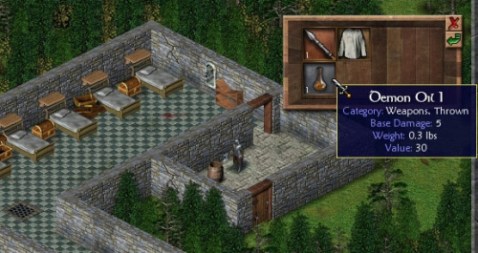
“This,” he said, “is going to be one of those games that’s like a roguelike with its nitpicking attention to detail but without its relentless powergaming to take the edge off, isn’t it?”
“I’m afraid so,” replied the narrator. “You might want to get a drink.”
The trouble with talking about games that are deliberate throwbacks to an earlier period of gaming is that critiquing them is like critiquing nostalgia. You can tell me time and again that gaming has moved on a great deal since Kirby’s Adventure or Super Metroid, for example, and you’d be entirely correct in saying so, but that’s not going to make me like either game less. Handing someone a title like Eschalon Book 1 is like being asked to tell someone why their fond memories of an earlier age are wrong or confirm that they’re totally right and games suck now.
There’s your salt to munch on whilst I tell you that this is exactly the sort of game that made me reluctant to get into PC gaming for a really long time. Much like there’s a spectrum of racing games you can make, there is a spectrum of different RPGs you can make on a computer, and Eschalon falls firmly on the side of the camp that I don’t think I’ll ever be able to get into. The reason being that I was a teenager, I played Dungeons & Dragons, and I would prefer to avoid this attempt to replicate that experience.
Telling Stories: Fitting in the circle
 I was introduced to the idea of character circles a long time ago, in an essay about writing Transformers fanfic of all the things in the world. Needless to say, that’s not my usual go-to source for writing advice or roleplaying advice, but it’s still a good idea, and it’s one that I’ve internalized over the years as being extremely useful for both. Especially if you’re dealing with characters who change a lot over time.
Let’s be honest and admit that characters in roleplaying can be somewhat… fickle. They’re probably being consistently played by one person, yes, but your moods change, circumstances change, and what seemed like a perfectly good idea with your character yesterday doesn’t seem like one today. Over time, you get a feel for what your character will or will not do, but that doesn’t change the fact that sometimes you just make a call and it might be almost entirely arbitrary. What you need to describe your characters isn’t a biographic listing of characteristics; what you need is a circle.
Challenge Accepted: The virtues of easy

Why play this instead of something harder? I can think of dozens of reasons.
If you can’t understand why someone would want to play an easy game, I don’t think you understand why people play video games at all. I’m not saying you have to want to play one, I’m saying you have to understand why someone will do that. No, saying “because they can’t play well enough to be at the top” does not qualify as understanding.
I like talking about challenge in games – a lot – but I also can’t stand the chest-pounding portion of the general gaming audience who seems to collectively believe that if you’re not turning every game into an arduous challenge then you’re obviously unworthy of purchasing any more games over the course of your life. As if there was no way to enjoy a game that tried just being easy, as if there was nothing to be derived from a game that’s not terribly deep, as if there was no modulation or middle ground between people who enjoy challenges and those that enjoy challenges. Or, for that matter, as if every game wasn’t easy in the right light.
Spoiler warning: all of the above are true.
 Recent Work
- An error has occurred; the feed is probably down. Try again later.
Chocobo Dash
- An error has occurred; the feed is probably down. Try again later.
 Eliot Lefebvre