Hard Project: Mega Man

What’s so funny about robotic cats, dogs, and birds?
You are surprised. No, that is not correct; you are flabbergasted. “Mega Man is an IP for video games!” you scream. “Are you on the drugs?!”
No, gentle reader, I am not on the drugs. I am looking at the writing on the wall, and that writing is not good for the spunky little robot. The last game in the franchise was released in 2010, and that was after a two-year drought; before that, there was another lengthy period of time in which new games occasionally trickled out, but there was certainly no sense that the franchise was alive and healthy. If you disregard the intentional throwbacks of Mega Man 9 and Mega Man 10, the original series hasn’t had a new installment since 1998. (Disregarding the remake of the first game.) Mega Man’s games are more likely to be cancelled than launched.
Heck, for all this talk of it being a franchise, the parts that defined the initial franchise haven’t been seen outside of Mega Man and Mega Man X; as much as I love Mega Man Legends, it’s not really in the same food group as the original series. There’s a reason why Keiji Inafune left Capcom to start a totally new company for Mighty no. 9, a spiritual successor to the franchise. Because much as I love these games, at this point they definitely qualify as hard projects.
Demo Driver 8: Assault Android Cactus (#202)
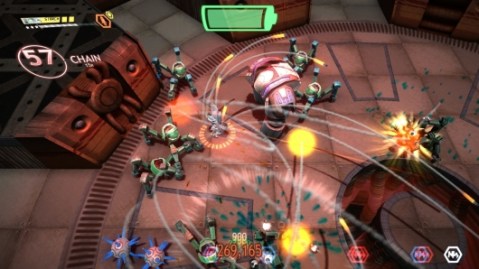
We’ve never really moved on from television of the smashiest variety, have we?
I am not, as a rule, one of the people for whom Greenlight is intended. This is because I enjoy cooking.
Cooking is delicate. Cooking takes time. Cooking is not particularly helped by having people clustered around eager to taste what you haven’t finished cooking yet. It’s not that I think the companies on Greenlight are wrong in some fashion, just that launching there means you’re buying a chance to taste something that the designers freely state isn’t yet cooked through. I’ll wait until you’ve finished with the cooking portion, thank you.
Assault Android Cactus is a Greenlight game, however, and one with a demo available. And it’s what I rolled, so it’s where I’m going. That having been said, what is present in the demo is quite polished and fun, although I harbor vague doubts about how much more you get at the moment for being an Early Access purchaser. But time enough for that elsewhere, let’s take a look at what the game actually is.
Telling Stories: Thinking like a television with your characters

Playing my main character in Star Trek Online has been illuminating. She had her own gig for several seasons, and it was interesting, watching her go from a fresh-faced Lieutenant to a Captain through sheer pluck and determination. Season 1 was mostly about her sorting out her crew and how she related to officers frequently trained not to accept a Cardassian in command; season 2, meanwhile, was much more focused around her past and what she actually intended to do with her command. It wasn’t until season 3 that she really started exploring how she interacted with other officers, developing friendships and rivalries; but she left a lot of that behind when she climbed just a little higher. Now she’s in season 4, and she’s learning that it’s quite lonely at the top of the ladder, and perhaps not as focused on what she actually finds important.
Obviously Star Trek Online focuses its updates into what it calls seasons, but just as obviously not what I’m talking about here. Organizing your character’s past and present into seasons and story arcs can be a major boon to playing your characters while keeping a strong sense of their development over time. Even though much of the time you’re going to be imposing order after the fact, it’s still a good way to organize your thoughts and get a good sense of the past without becoming overly bogged down in details.
Challenge Accepted: How games challenge you

Sometimes it’s just challenging to keep your feet underneath you.
Consider a simple game for a moment. Your objective is to tap a key as fast as you possibly can, let’s say the letter X. Every time you hit the key, your score goes up by one. If you stop hitting the key for five seconds, your game ends. Now let’s consider another equivalent game with a different end condition: if you don’t alternate between X and C, your game ends, although you can take as long as you like between presses.
Both games are functional, both offer a challenge, and both could be dressed up to provide a sense of opposition. (Although sometimes all we need is a Flash interface telling us to hammer on the X key to waste two hours of an idle afternoon.) But this isn’t the same game repeated. There’s a different challenge in both versions. In one, it’s all about speed; in the other, it’s memorization. If you’re going to think about challenge, you have to think about more than just the existence of same and more of the types that can be faced.
The Final Fantasy Project: Final Fantasy I, part 5
Artwork from a sketch by Yoshitaka Amano
You know, I’ve tried really hard to keep this project free of personal quirks. Not in the sense of making this less of a personal experience, but insofar as I recognize that some things I think are cool are just strange on an objective level. Having said that, I still think the ending of Final Fantasy is really neat on a conceptual level.
If you’ve been paying crazy careful attention to the map, you realized that all four Fiends were located at points equidistant from the Temple of Fiends. You don’t even think about how weird it is that the first dungeon in the game is the Temple of Fiends until you’ve been through most of the game. And yet there it is, staring you in the face – the bats surrounding Garland, the black orb right behind him, the nature of its location. It all comes around to the same circle. Garland is the root of everything. Your first boss is your last boss.
 Recent Work
- An error has occurred; the feed is probably down. Try again later.
Chocobo Dash
- An error has occurred; the feed is probably down. Try again later.
 Eliot Lefebvre