The Final Fantasy Project: Final Fantasy V, part 5
Artwork from a sketch by Yoshitaka Amano
I made a passing comment at the end of the last article that I think deserves to be unpacked a little bit, because it’s the basic problem that every single Final Fantasy game since Final Fantasy V has been trying to solve. How do you allow characters to share abilities while still making all of the diverse classes available be worthwhile for something unique?
The reason this comes up is because of things like Beastmaster. As a class, Beastmaster is pretty awful. Its big tricks aren’t useful, it doesn’t provied more damage or healing than any other class, and the one thing it has in its favor is the ability to control an enemy. That sounds pretty screamingly useful, to boot… but then you realize that there’s no need to actually put that ability on a Beastmaster. Why would you not just grind for a little bit on Beastmaster, unlock Control, and then never touch it again?
Such is the plight of several jobs in the game. Such is, in fact, the plight of several jobs in every game, but this is the point where the struggles begin. In Final Fantasy III, there were a couple of classes you could get away with never using, but a majority of those jobs were useful somewhere even if you weren’t likely to use them from start to finish. In Final Fantasy V, even decent jobs pale compared to the jobs that combine nicely with other jobs.
Demo Driver 8: Letter Quest: Grimm’s Journey
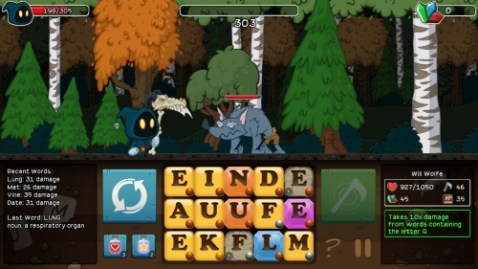
I fought a werewolf with nothing more than weaponized words. That’s what I did today.
Bookworm Adventures was always weird. In a good way, mind – I think the weirdness of the very premise had a charming quality, albeit happily disconnecting from anything resembling reality by simply deciding that forming words deals damage and going from there. It is, in many ways, the logical precursor to games like Puzzle Quest and Gyromancer, games with love for the RPG model but with an eye toward making the mechanics of fighting things a bit more unusual.
You cannot, however, call it the “logical precursor” to Letter Quest: Grimm’s Journey without being exceptionally generous with your use of that term, because it’s the same damn game. Letter Quest, top to bottom, is so close to Bookworm Adventures that calling it even a spiritual sequel is a bit too gentle. It’s the same core game with a slight facelift, a different look to it, and new challenges for you to clear through as you plod along through some story or another that’s not terribly well-defined and mostly exists so you can kill monsters with letter tiles.
That’s really not to its detriment, though.
Telling Stories: Sexuality without the skeevies
 I’ve said before that sexuality is part of roleplaying, because it is. It’s part of the human condition, it’s a valid thing to explore in roleplaying, and it’s going to happen anyway. But there’s a line between involving sexuality in your roleplaying and making it the sort of involvement that makes everyone around you look at you with narrowed eyes and intense discomfort.
This has come up a fair bit in the Final Fantasy XIV community of late, for kind of disturbing reasons that serve as an excellent highlight of the issue. Because there’s a race of adults that are clearly meant to look like human toddlers… who are also very definitely sexually mature. Which raises a lot of uncomfortable questions about the characters being played in the real world by adult humans.
Fantasy is, of course, fantasy. But it’s useful to understand how fantasy lines up with and can be influenced by reality, and to understand why one might make the other far more uncomfortable. It’s important to have sexuality as a component in roleplaying, but it’s also important to do so in such a way that no one gets disturbed by it.
The Final Fantasy Project: Final Fantasy V, part 4
Artwork from a sketch by Yoshitaka Amano
So the protagonists of the game are currently not doing well at their stated goals. Two crystals encountered, two crystals destroyed. In their defense, the job wasn’t theirs until the wind crystal was already in bad shape and the water crystal sort of happened without their consent. Nevertheless, based on series history I’m sure that the other two crystals will wind up being just fine.
Well, they might.
All right, so it’s a foregone conclusion what’s going to happen from here. The important thing is to keep moving on despite that fact, after stopping to have a brief chat with the King to indulge in a round of the “We Told You So” dance. To his credit, he’s already realized that he probably should have listened to the group in the first place, not that it helps him a whole lot now. But Walse wasn’t the only kingdom amplifying its crystal with machinery, and the kingdom of Karnak seems poised to be the next victim of… whatever is going on now.
Hard Project: Otherland
Wastelands, teenage or otherwise.
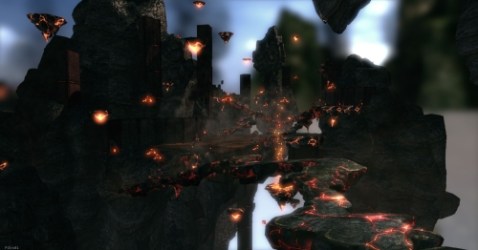
There are a lot of things that I really like about Otherland, one of them being the simple fact that it followed the age-old trick of making the future seem real by only looking forward a little bit and making reasonable assumptions. The story doesn’t take place in the year 1999 on a space liner, is my point. Sure, VR technology didn’t become the focal point of computing for a lot of reasons, but the world put forth in the book feels plausible.
At a glance, it’d make a pretty cool game.
The Otherland MMO has shuffled developers and publishers more than once, but it always seemed like a really bizarre concept to me based off of reading the story’s setting far too literally. Not that it’s the fault of the programmers, who doubtlessly just wanted to adapt a vivid and interesting world to play in. At a glance, this seems like a no-brainer for a project; it’s only on closer examination that you realize the whole thing is damn-near impossible to pull off, and not terribly rewarding if you do.
 Recent Work
- An error has occurred; the feed is probably down. Try again later.
Chocobo Dash
- An error has occurred; the feed is probably down. Try again later.
 Eliot Lefebvre