A helpful guide to Western and Eastern RPGs

This game tries to trick you into thinking it’s one thing and then it becomes something else. Surprise!
As you have probably been able to ascertain from the fact that I have an entire series of columns on this very site dubbed “The Final Fantasy Project,” I have a bit of a thing for RPGs. They’re fun! And I’ve played a lot of them over the years, some of them from the Land of the Rising Sun, others from the Land of the Rapidly Diminishing Water Supply (better known as “California”). Or the Land of the Snows and Hockey (Vancouver?). The point is, there are two different distinct design systems at work when it comes to computer RPGs, that’s what I’m getting at.
Pop culture being what it is, of course these two philosophies have to be at war with one another, and you are expected to have passionate points of view on the matter about which one is better. But some of you might not have time to carefully play through earlier installments of beloved franchises to pick out which one is better, and quite frankly no one should ever be forced to play through several portions of the Ultima series or the Fire Emblem series without the promise of a paycheck. Thus, I’ve assembled a quick guide to both sides, helpfully explaining what these things are with an eye toward pissing everyone off equally.
I would be thankful

If you’re in America, like me, you’re eating one of these today.
For a couple of years, I had a regular column that inevitably ran on Thanksgiving. Never one to pass up an opportunity for an easy gag that tickled my fancy, the joke was that every single year saw me wishing readers a happy every-holiday-other-than-this-one. I didn’t have enough time to eventually move into St. Swithin’s Day, but given enough time I am certain that would have happened. I can, in fact, be dreadfully predictable every so often.
This year, I do not have that duty. Instead, I’m sitting here and thinking of the many things I do have to be thankful for this year – a successful first year of marriage, the excellent reception I’ve gotten for this project thus far, Final Fantasy XIV, Defender’s Quest, BoJack Horseman – along with the many things that I can’t be thankful for because they aren’t, strictly speaking, real. They should be real. I think all of them are pretty self-evident, inevitable, and we’ll be happy when they come around. But the sooner these things pass into the desert of the real, well, the more thankful I’ll be.
The dark heart of Final Fantasy XI
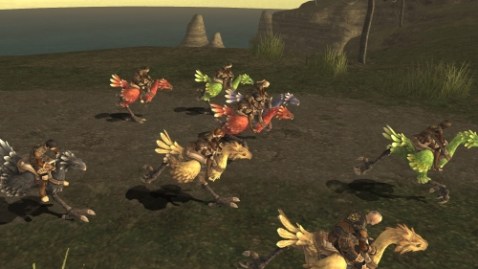
You know it doesn’t want you there, but you can’t help but feel a stirring of nostalgia.
When Final Fantasy XI launched in America, it received a pretty shining reception, which should say a lot about MMOs at the time. This release was a port of a game programmed for a very specific Playstation 2 peripheral, released long enough after its initial launch that a significant portion of the existing Japanese playerbase viewed the incoming American players in much the same way that you would view an army of roaches assembling just outside of your front door. The resultant culture clash and sheer ambiguity of the way the game functioned led to problems that Square-Enix is still pretending to clean up, not to mention that it included PlayOnline, a service so magnificently useless that it makes Games for Windows LIVE seem almost fashionable.
It was problematic, is my point. And that isn’t even getting to the actual game, which I’ve previously said is sort of like some bizarre outgrowth of Stockholm Syndrome, constantly assaulting you for the crime of trying to play it even while you find yourself aware of its deep-seated loathing and contempt for players. And yet the game did well. It was a success. It’s still relatively successful now, more than a decade out from its launch, warts and all.
Like any game, there are lessons to be learned here.
Challenge Accepted: Breaking out of the challenge box
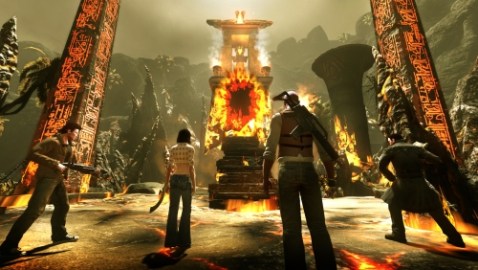
The game is substantially helped by its fair assortment of hellmouths in need of closing despite everything.
Playing The Secret World was in many ways both satisfying and infuriating. On the one hand, here’s an MMO that genuinely wanted its players to be engaged with puzzles beyond simply clicking on the right answer from a short and obvious list. That’s kind of awesome. On the other hand, the actual puzzles it had were highly reliant upon you scanning through fake websites, assembling clues very vaguely hidden in context, and then producing a synthesized answer. Or, as was far more often the case, looking up the solution online and skipping that whole tedious and unenjoyable aspect.
Still, there’s something to be said for the fact that the game did earnestly try to provide a challenge for its players that stretched beyond the norm. It was trying to challenge players beyond the usual sides of gameplay (which ties into that bit I outlined near the start of this feature) or simple common-knowledge trivia, asking players to flex a different skillset. They’re challenges that rely partly on things you’re not usually asked to do and partly upon the fact that you’re taught there’s a certain way video games play.
 Recent Work
- An error has occurred; the feed is probably down. Try again later.
Chocobo Dash
- An error has occurred; the feed is probably down. Try again later.
 Eliot Lefebvre