Just because you’re wet doesn’t mean it’s raining

I don’t expect a grand, stirring tale, but I expect one that isn’t an incoherent, stupid, shrieking mess and features characters I actually like to see on screen.
I’m not fond of excuses when it comes to critical thought. You hear a lot of them thrown around consistently, usually that a given film wasn’t supposed to be winning awards, so why are you critiquing it? Because apparently it’s impossible to both be a good action film and not insultingly stupid, never mind that Pacific Rim showed us exactly what Transformers could have been with a better script instead of the blaring obnoxious films that we’ve seen for years now. Just because a film is meant to be entertaining action doesn’t mean it also has to be bracingly stupid.
We need to tear down the idea that critical thought and questions somehow need to step out of certain discussions. It is possible for something to both be a straight action piece meant to show off cool hardware and explosions while also being a likable piece on its own merits. You do not get to defend blockbuster titles on the premise that they’re meant to just be action extravaganzas, as it’s possible to have both. But that’s the least of the defenses that I want to skewer and be rid of.
Demo Driver 8: Hard Reset
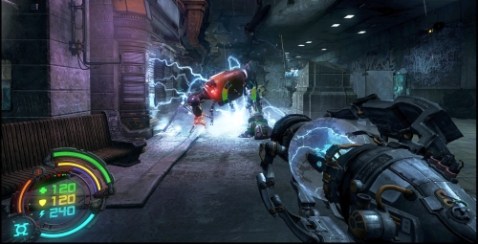
Robot rocked.
Let’s start this real simple-like: Hard Reset is what Serious Sam wanted to be.
I wasn’t too fond of Serious Sam, partly because my love of old-school FPS games is strongly tempered by the fact that I do not have a love of old-school FPS games. I acknowledge them, sure, and I had fun with Doom and Marathon back in the day, but that love faded fast and can now be found only in a handful of things here and there. But also because it was, well, kind of boring.
By contrast, Hard Reset‘s demo makes it very clear that it understands why these games worked and what parts were vital. It is by no means flawless, and it has things that others have pointed out as being kind of odd hiccups in the whole “relentlessly old-school FPS” layout, but it is clearly hitting the notes it wants to. Heck, I was enjoying it quite a bit, and I’m not even the target audience.
Anonymity isn’t the issue
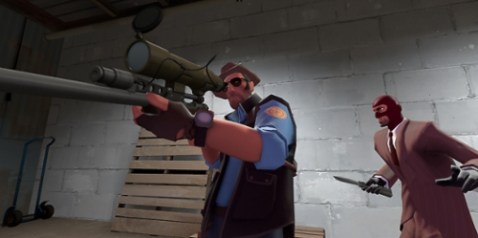
It’s not the fact that you don’t have to look at yourself that lets you get away with it.
After years of seeing comments on the Internet, I’m pretty sure that everyone’s conception of what causes asshole behaviors online is off the mark.
You cannot discuss people being jerks online without someone bringing up that damn Penny Arcade strip. Which is not a sociological paper, I know, but neither is this. Every discussion I’ve seen about people acting like dicks to others online is based around this assumption, that when you give a random person the option to be anonymous they instantly turn into a raging monster to whomever happens to be within spitting distance.
This is neglecting the many people who don’t do this, obviously. But it’s also ignoring the fact that we’re not anonymous on the internet, certainly not in the ways that this line of thinking suggests. We have our user names, we have our identities, we have ways that we’re marked. A five-minute stretch of Facebook makes it clear that anonymity isn’t what’s fueling the behaviors that we take as the price of doing business online. Or, more accurately, it is – just not in the configuration we think it is.
Challenge Accepted: The puzzle roadblock

Looked at in a broad enough sense, every game is a puzzle game, and the differences just come down to how it’s puzzling you.
I recently found myself playing through Half-Life 2 again for reasons that are not clear to me. But that’s not the important point right now; what’s more important is that I was struck, not for the first time, at how tedious stretches of the game could get. The tense, brutal firefights were great, but then suddenly I’m in Ravenholm and dealing with millions of small enemies nipping at my heels without any ammo to be found. Or I have to piece together another physics-based puzzle. Or I’m doing anything related to the game’s vehicles. Or the goddamn antlions and sand.
None of these are segments that are unfamiliar at this point. I know how to get through all of them with a minimum of fuss. But they wind up feeling tedious for various reasons, and every time I hit another one of these roadblocks I rolled my eyes in irritation. Which seems an apropos condition, because in some games, the puzzles evolve naturally from the existing gameplay, but in others they’re just a way of padding out the game until you get to the next good part.
What’s a success?

I wanted to come here when it was peaceful. Mission accomplished.
I woke up this morning to a hug from my wife, and it was lovely. Is that success?
While I don’t talk about it a lot here, I spend a lot of time thinking about what I’m doing, what projects I’m pursing, and generally raking myself over the coals for where I am in life as a grown adult. I look at what I’ve accomplished and I feel like I could have done more, that I could be further along than I am right now. Then I look at where I am and wonder if I’m further along than I tend to believe that I am. Then, usually, I pet the cat.
Success or failure is a big deal in basically every industry. We judged whether a game or a movie or an album has succeeded or failed. The problem isn’t that we do that, it makes sense, there’s a good reasoning behind it. And yet at the same time there’s a real challenge in any industry judging success or failure, because there’s so much more going on than the obvious metrics, and those metrics are lying bastards.
 Recent Work
- An error has occurred; the feed is probably down. Try again later.
Chocobo Dash
- An error has occurred; the feed is probably down. Try again later.
 Eliot Lefebvre