Demo Driver 8: Sugar Cube: Bittersweet Factory (#447)
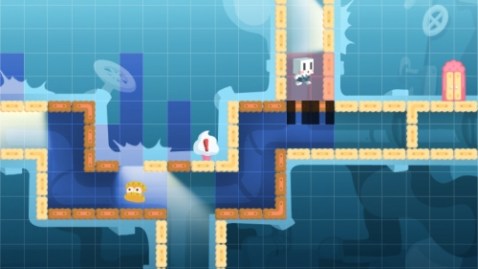
It would be really nice if even the designers could get a single shot of this game that did not make it look unbelievably messy, because that certainly turned me off.
The vast majority of games are mediocre. We all know this even as we don’t really think about it. Your game collection is, I’m sure, filled with games that you consider actively good rather than lackluster, and it’s easy to sort of extrapolate outward from that. Most of the games you can find aren’t bad, though, nor are they really all that good. They’re just… there. They work. They’re not worth feeling a great deal of joy or sorrow over. They’re mediocre. Filler. Likely impossible to have any strong emotions about either way, even.
Sugar Cube: Bittersweet Factory is a game that is mediocre in every way, shape, and form. It is yet another puzzle platformer in which you move from screen to screen and try to figure out how to bypass the game’s obstacles to get to the end. It is also another game that falls victim to the “demo cannot sustain half an hour of play” curse that I get all uppity about, but even with that being said I feel I have a relatively solid grasp of the game from my limited play time. It’s neither bad nor good. It’s just there.
Challenge Accepted: Why fake difficulty is still a thing
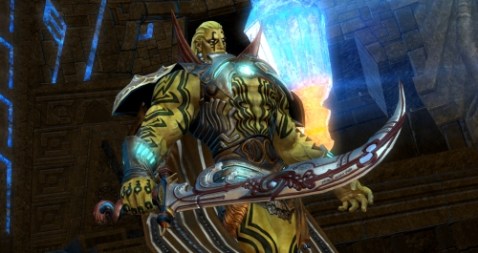
Fakin’ it.
Fake difficulty isn’t a term of praise. Which is kind of obvious from the name, I know.
If you’re not well-versed in fake difficulty as a named concept, you’ll still know it when you see it. The mandatory stealth section when this game had not required any stealth gameplay before now. The camera angles that shift when you make a jump. The sudden mechanical shift into a whole new sort of game that you may not be any good at. A hunt for an object that would be easy to find… if not for the total lack of distinguishing marks from the background.
TVTropes does a good job listing the many, many flavors of fake difficulty, but it only briefly touches upon the fact that it’s not entirely bad. There are a few reasons it still shows up in games, though, and while some of them are bad, a couple of them are actually better than the alternative. So why is fake difficulty still a thing?
Creating the environment

You threw me into the arena, don’t be surprised that I plan to fight now.
During a conversation the other night with a fellow Final Fantasy XIV player, a statement was made: “It’s not the developers’ fault how players behave.” Which intrigued me, because it’s a sentiment that I see a lot, and one that makes logical sense. It’s also one that’s almost entirely wrong.
Obviously, developers are not coming into your house at night to tell you how the game should be played, or including notes in the instruction manual. Although that would be kind of funny from a perverse standpoint: “press A to jump, but don’t do it in level 3 because that’s not the right way to play.” But the developers are totally telling you how to play, and if you’re breaking the game or playing in a way that’s not fun for you or anyone, that’s entirely the fault of the development team.
It all comes down to the environment you create and what you encourage. Because that’s what tells you how to play the game anyway.
Game companies feel like people

If game companies were more like cats, I think I’d like them more.
It all started when I was thinking about BioWare.
I like BioWare, if you didn’t know. I like them quite a bit. Sure, the studio has made missteps here and there, they’ve goofed up, they haven’t been as good as I know they can be. But the studio is trying. I realized that more than anything, they feel like someone worth knowing. Sure, they’re going to blow it occasionally, but not because they’re bad, just because everyone makes mistakes, and they seem to take their mistakes in stride and move on.
That, of course, led to me thinking about how many other companies feel like people instead of just machines made to take money. Yes, that’s what they are, but if the Supreme Court keeps insisting that corporations are entitled to all of the same benefits as individual people, we might as well start talking about these studios as people, right? It seems only fair.
Telling Stories: Catching up mechanically
 When Final Fantasy XIV releases Ninja, it’ll be a nice day for me, particularly singe I’ve been playing one for the past four years. No, not through an unholy amalgam of abilities put on my bar in service to a rather strange overall cause, but in-character. My character should, by all rights, be dual-wielding and hacking things apart, then slipping back into the shadows. That’s her entire deal. This is not a bold new direction for her, it’s more like an acknowledgement of where she’s already been.
Of course, I’m also lucky insofar as this is a game where it’s very easy – encouraged, even – to swap between classes on a regular basis. The only setback this will pose is that I’ll have to put a bit of extra effort into assembling her weapon and armor sets, something I can probably start doing with the next major patch anyway. But it still raises the question of why she hasn’t been doing this on a regular basis before now. How do you handle it when the game finally catches up mechanically to the place you’ve already been?
 Recent Work
- An error has occurred; the feed is probably down. Try again later.
Chocobo Dash
- An error has occurred; the feed is probably down. Try again later.
 Eliot Lefebvre