Telling Stories: Thinking like a television with your characters

Playing my main character in Star Trek Online has been illuminating. She had her own gig for several seasons, and it was interesting, watching her go from a fresh-faced Lieutenant to a Captain through sheer pluck and determination. Season 1 was mostly about her sorting out her crew and how she related to officers frequently trained not to accept a Cardassian in command; season 2, meanwhile, was much more focused around her past and what she actually intended to do with her command. It wasn’t until season 3 that she really started exploring how she interacted with other officers, developing friendships and rivalries; but she left a lot of that behind when she climbed just a little higher. Now she’s in season 4, and she’s learning that it’s quite lonely at the top of the ladder, and perhaps not as focused on what she actually finds important.
Obviously Star Trek Online focuses its updates into what it calls seasons, but just as obviously not what I’m talking about here. Organizing your character’s past and present into seasons and story arcs can be a major boon to playing your characters while keeping a strong sense of their development over time. Even though much of the time you’re going to be imposing order after the fact, it’s still a good way to organize your thoughts and get a good sense of the past without becoming overly bogged down in details.
Challenge Accepted: How games challenge you

Sometimes it’s just challenging to keep your feet underneath you.
Consider a simple game for a moment. Your objective is to tap a key as fast as you possibly can, let’s say the letter X. Every time you hit the key, your score goes up by one. If you stop hitting the key for five seconds, your game ends. Now let’s consider another equivalent game with a different end condition: if you don’t alternate between X and C, your game ends, although you can take as long as you like between presses.
Both games are functional, both offer a challenge, and both could be dressed up to provide a sense of opposition. (Although sometimes all we need is a Flash interface telling us to hammer on the X key to waste two hours of an idle afternoon.) But this isn’t the same game repeated. There’s a different challenge in both versions. In one, it’s all about speed; in the other, it’s memorization. If you’re going to think about challenge, you have to think about more than just the existence of same and more of the types that can be faced.
Expanding beyond Titanfall’s server limitations
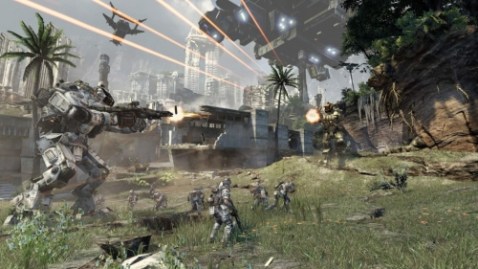
A game about giant robots can now be played almost entirely with robots.
Last week, Titanfall set up what I think is a very fair penalty system. If you are caught cheating, you are not banned, you’re simply banished to a server where everyone else is also a damn cheater. So you will be more than able to enjoy the game, if what genuinely makes the game fun for you is playing amidst a field of cheating bastards.
Incidentally, that was the original title for Sting’s “Fields of Gold,” I believe.
I feel this is an excellent first step, but by no means the final one. This is a brilliant concept that is almost infinitely expandable, allowing companies to ensure that players get to live with the people what will nurture and understand them. Or at least understand them. All right, that’s not really what I’m concerned about so much. There are toxic and vile people on the internet who seem to enjoy spreading vile toxicity into the games that we love, and perhaps we could use this same methodology to deal with people best surrounded by one another in the hopes that they may realize “wow, I am extremely annoying.”
Hard Projects: Star Trek
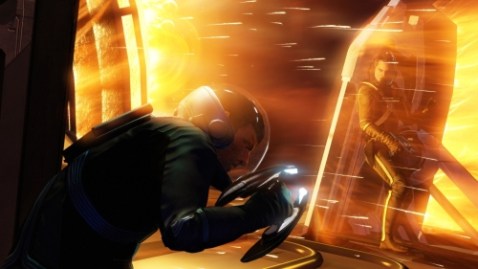
It’s the reviews, sir, and they’re not happy!
There’s no way I could convince anyone reading this that I don’t love Star Trek Online. I wrote a whole piece about it. And it’s all true, Your Honor, I think it’s a great game that comes as close as any game has to capturing the spirit of the series. In fact, it might even seem unfair to list Star Trek here at all, seeing as we’ve been nearly buried under a variety of Star Trek games with varying critical reception. Some are seen as particularly good, some are seen as middling, but very few houses get the license and turn out something execrable.
Yet it’s always a tricky prospect. Star Trek Online languished in development hell for an extended period of time, killing the first studio working on it. Many of the games languish in that impermanent hell toward the bottom of the “acceptable” scale when they hit review time, many of them sliding below that. And nearly every single one faces criticism about its use of the license, with people hand-wringing and asking whether or not the game really fits in with the ethos of Star Trek as a whole.
So what makes this so hard to adapt?
Telling Stories: Being polite to roleplayers
 So you don’t roleplay. Maybe you did at one point but don’t any longer. Maybe you never have and are curious, but are a little put off by what seems like arcane terminology and the looming threat of skeevy behavior. Maybe you’ve never cared to but just don’t like being a jerk. Maybe lots of things. The point is, you’re not roleplaying, and you come across people who are actively roleplaying, either because you intentionally chose a roleplaying server to play on or because you just found it lying there.
Because you fulfill the basic requirements for human empathy, you don’t want to be a jerk. But how do you do that? How do you interact with roleplayers, possibly even observing them, without being a twit or in some way damaging what they’re doing? As it turns out, it’s not that hard. So whether you’re just on the outside of roleplaying or you’re deeply invested and want to show this to others, let’s talk about being polite to roleplayers when you aren’t one.
 Recent Work
- Vague Patch Notes: Cringe is good
- Goop vibes: Warframe’s Shadowgrapher update is live along with the Switch 2 launch [Updated]
- The Daily Grind: Is there any MMO merch you wish existed that doesn’t?
- Final Fantasy XIV kicks off another Moogle Treasure Trove starting on March 31
- Boomer shooter Nightmare Reaper and voxel sandbox Teardown have added proper multiplayer support
- Perfect Ten: MMOs whose sequels struggled to land
- World of Warcraft releases a new song in collaboration with AURORA to celebrate Midnight’s release
- Spiritvale adds cosmetics, pets, and mounts to the game with its latest pre-early access update
- Aska’s latest update makes villagers eat less and go to the tavern properly
- Final Fantasy XIV’s Naoki Yoshida cites long development cycles as a problem for the franchise
Chocobo Dash
- An error has occurred; the feed is probably down. Try again later.
 Eliot Lefebvre