A virtual gun and good entertainment (or why you still need to play Spec Ops: The Line)
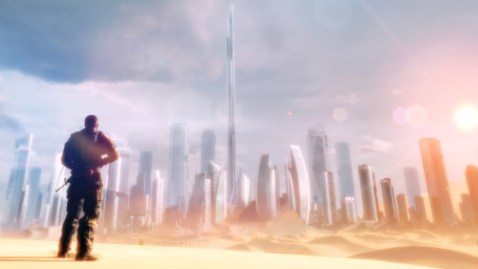
The heavenward spire never looked so foreboding.
There’s something unsettling in playing Spec Ops: The Line, long before its major twist really falls upon you. Oh, sure, it plays like a conventional third-person shooter as you storm along and gleefully pull the trigger on your gun, but right from the start there’s something unsettling therein, something that gnaws at you. The environments are too claustrophobic, the dialogue too close to the edge of snapping and growling, every moment too pitched and agitated for what’s going on. Sudden slowdowns punctuate combat as you kill people, seemingly without reason, the camera and the events around you drifting slower as if to give you just enough time to really think about the life you ended.
Of course, at this point you don’t need me to tell you what the deal is with the game. It’s been raved about critically, praised as a deconstruction of the real-is-brown military gun-porn shooter by more or less every outlet in existence. Sales weren’t what they could have been, but it succeeded at its goal. But how much merit does it still have? When you know the gut punch that it’s aiming for you, is it still as effective? Does the game still have a point when the only audience that’s going to remember it is the audience that has the least need of it?
Telling Stories: Fitting in the circle
 I was introduced to the idea of character circles a long time ago, in an essay about writing Transformers fanfic of all the things in the world. Needless to say, that’s not my usual go-to source for writing advice or roleplaying advice, but it’s still a good idea, and it’s one that I’ve internalized over the years as being extremely useful for both. Especially if you’re dealing with characters who change a lot over time.
Let’s be honest and admit that characters in roleplaying can be somewhat… fickle. They’re probably being consistently played by one person, yes, but your moods change, circumstances change, and what seemed like a perfectly good idea with your character yesterday doesn’t seem like one today. Over time, you get a feel for what your character will or will not do, but that doesn’t change the fact that sometimes you just make a call and it might be almost entirely arbitrary. What you need to describe your characters isn’t a biographic listing of characteristics; what you need is a circle.
Challenge Accepted: The virtues of easy
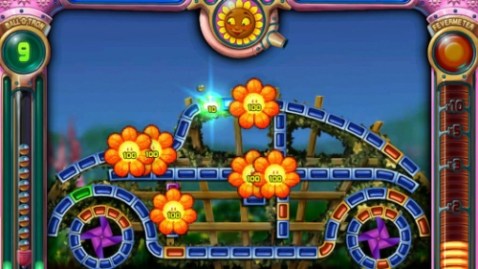
Why play this instead of something harder? I can think of dozens of reasons.
If you can’t understand why someone would want to play an easy game, I don’t think you understand why people play video games at all. I’m not saying you have to want to play one, I’m saying you have to understand why someone will do that. No, saying “because they can’t play well enough to be at the top” does not qualify as understanding.
I like talking about challenge in games – a lot – but I also can’t stand the chest-pounding portion of the general gaming audience who seems to collectively believe that if you’re not turning every game into an arduous challenge then you’re obviously unworthy of purchasing any more games over the course of your life. As if there was no way to enjoy a game that tried just being easy, as if there was nothing to be derived from a game that’s not terribly deep, as if there was no modulation or middle ground between people who enjoy challenges and those that enjoy challenges. Or, for that matter, as if every game wasn’t easy in the right light.
Spoiler warning: all of the above are true.
The Final Fantasy Project: Final Fantasy II, part 6
Artwork from a sketch by Yoshitaka Amano
I realize that I’ve been pretty hard on Final Fantasy II up to this point, generally for good reason. The game has a lot of ambition, but ambition is only commendable insofar as it leads you to reach upward, and this is a game that continually falls short of where it wants to be. What was innovative more than twenty years ago is less so today, and even then I imagine these holes and weaknesses were visible to players; breaking the game’s mechanics is hardly a new thing, for instance.
That having been said, the Mysidian Tower is kind of thoroughly enjoyable. It’s a dungeon where all of those well-designed dungeon elements that the game has sported can really get up and do a dance, and the enemies have tricks that feel like they’re at least meant to be interesting rather than annoying. I couldn’t autopilot through these fights, but neither did I find myself painfully bored as I made my trek.
Where did World of Warcraft go wrong?
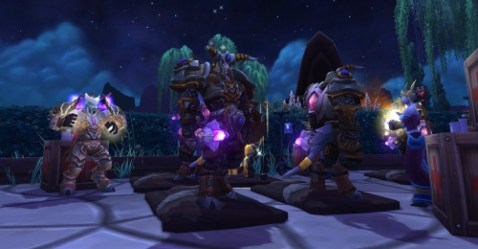
I should not be looking at an expansion filled with draenei and not be excited. This is literally everything I’ve ever wanted.
Something is rotten in the state of Azeroth, and it has been for a while.
The problem of talking about World of Warcraft‘s decline is that no one is interested in doing so. The game’s fans are eager to point out that the game still has an impressive number of subscribers rather than talking about the fact that, on average, the game has been losing more than a million subscribers per year since the launch of Cataclysm. The other side of the coin likes to forecast the game’s death, neglecting to acknowledge that even if the game keeps bleeding off subscribers at this rate it’s got several more years of life left in it while discounting spikes.
But there’s a frank discussion to be had, one that doesn’t invest itself in hyperbole, and it’s obvious that the game is on a downward arc. Over the past four years (Cataclysm launched at the very tail end of year six) the game has lost an extraordinary number of subscribers. Its growth has stalled. This is a stark reversal when the game was in an upward trend for the first six years of its lifespan. Why is that? What’s changed its fortunes so thoroughly? I wonder about that a lot, and I think a lot of it comes down to learning the wrong lessons from its height.
 Recent Work
- An error has occurred; the feed is probably down. Try again later.
Chocobo Dash
- An error has occurred; the feed is probably down. Try again later.
 Eliot Lefebvre