Demo Driver 8: Jagged Alliance – Back in Action (#65)
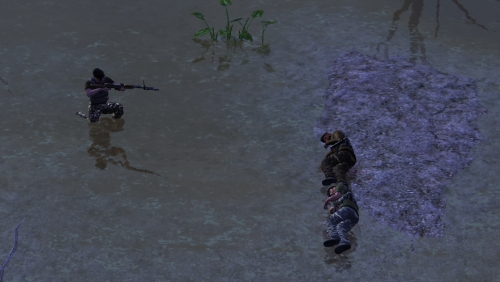
Dead in the water.
The best sort of demos make you intrigued about what the game has to offer. The worst get you bored with the concept.
Last week’s candidate was a demo for something that I wouldn’t call good, but it also wasn’t something I’d call bad. I felt like after taking my time, the demo left me with a good sense of what the game would play like, but also left enough blanks in the picture that I didn’t feel I could entirely satisfy any cravings simply through the demo. It was solid, it teased, it made its central hook known.
Jagged Alliance – Back in Action does not have a particularly good demo. In fact, what it has is a stilted tutorial and a single mission that both manage to remind me of why I long considered PC gaming to be far more tedious than it needs to be. And from research, it’s not really the fault of the franchise, but a combination of a developer doing a poor job of adapting a game and the demo doing an even poorer job of making the game seem enjoyable.
Challenge Accepted: The entry point

Source: Wikimedia Commons
The biggest problem that’s always faced Star Trek is pretty simple: continuity.
Not to say that it’s unique to Star Trek, but right now I’m watching through Deep Space Nine, and you can really feel the crunch of continuity as the show reaches its conclusion. Season 7 is more or less impossible to navigate or understand if you haven’t been watching since the beginning; nearly every episode is a densely woven net of references, allusions, and call backs to earlier events. It’s a lot of fun to watch, but I’d be completely out of luck if I hadn’t been watching the whole thing from the start.
So what does this have to do with challenge in games? Well, it’s the same sort of problem. The game industry has to keep bringing in new people, and that means that new players need to have a consistent entry point. Which creates a problem when dealing with veteran players, because what’s challenging to someone new to games isn’t going to present much trouble to someone with a long and storied history of gaming. Which brings us, appropriately, to the topic of entry points.
The Final Fantasy Project: Final Fantasy I, part 1

Artwork from a sketch by Yoshitaka Amano
The Final Fantasy Project is a look back over the franchise’s entire history, starting from the beginning and moving up to the most recent game when I finally finish this whole thing. Those of you who have followed my work in various places may remember that I already started this project over the summer, but it sort of fell off the radar between a combination of Final Fantasy XIV and the steady realization that the format I had picked was not actually a good one for what I wanted to do.
So consider this a revival. Not a reboot, though; I’m still pretty happy with what came out of my work over the summer, so the first couple of weeks are going to involve a repost and cleanup of what was written during the initial run. That’ll be compressed as much as possible, but if you really want to spoil yourself, the original versions are out there. So let’s start from the very beginning.
We’re probably not facing another game crash

Not the face of the future.
In 1983, the video game industry crashed. Imploded might be a better term, honestly. A huge plethora of game consoles had popped up everywhere, and a lot of companies that had otherwise been getting invested in video games backed out. It was pretty extreme, something that most students of game history look back at with a certain degree of trepidation.
After all, it all collapsed once. It could all collapse again. Our hobby hangs on by the slimmest of threads, it seems, and all it would take is the slightest pressure for everything to come crashing down. It’s why you see articles about how the game industry is heading for another crash every few months, generally written by men and women who know quite a bit about how the industry works and has worked. The people who make games no longer have a passion for games or care about games, we’re past market saturation, the circumstances are all right. It’s going to happen again.
Except it hasn’t happened. The game industry has had hiccups, but we’re 31 years out from the last crash, and it seems likely that we’ll avoid hitting another one. For a few reasons. Read More…
Demo Driver 8: Alien Breed 2: Assault (#249)

Stupid waist-high guardrails!
Do you know how many games there are on Steam? A lot. And there are a lot of demos out there, too, so many that you could use them to blot out the sun. Assuming the sun could be blotted out by game demos stored purely on hard drive space. That metaphor got a bit tortured, but I checked; at the time of this writing, there are 407 demos on Steam. So I’m grabbing one at random and playing through the demo, no matter what.
This week, I rolled 249, which set me up with Alien Breed 2: Assault. The title does not exactly inspire visions of breathtaking originality, but a stupid title doesn’t make for a bad game. So after Steam’s usual ridiculously complicated initial setup process, it was time to jump in and see about shooting the heck out of some aliens. No, I hadn’t really looked at the description on the store page, but be fair; with a title like that, there was only one game this was ever going to be.
 Recent Work
- An error has occurred; the feed is probably down. Try again later.
Chocobo Dash
- An error has occurred; the feed is probably down. Try again later.
 Eliot Lefebvre