Gyromancy, Magic of Gyroscopes
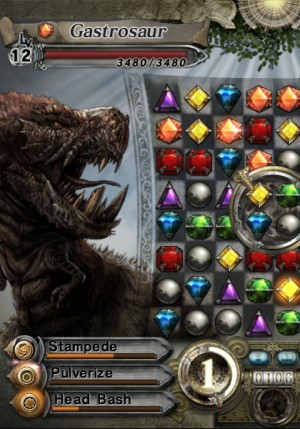
“Gastrosaur” seems less like a good name for a monster and more like a name for a dinosaur-themed restaurant chain.
Of all the games you’d expect to have started a trend, Puzzle Quest seemed like an unlikely candidate to say the least. I mean, the game as an admittedly bizarre blending of two or three totally unrelated games, and while it was fun it was also the sort of game where the random number generator ruled. One wrong move – or even one right move – could start a cascade of bolts to the face that ended with your destruction, and you couldn’t help but feel like balance wasn’t really in the top ten priorities of the designers.
Apparently, PopCap and Square-Enix felt that this was as good a foundation to improve upon as any. Hence, Gyromancer, a collaboration between the incarnate deities of casual gaming and the lords of… well… whatever it is Square is the lord of these days. The game fell into the trap of a lot of really neat projects, however, where the concept attracted a lot of attention and the actual game sort of fell off the radar after a couple of weeks. Even I forgot to purchase it when it came out a couple years ago, remembering early the following year as part of my “I am making money from journalism, let’s buy games!” rush.
An Ode To Smart Bombs

This was randomly on the front page of Kongregate when I clicked over. (The game is D.N.8, if you’re curious.)
They’re called by many names, but they only really need one. They are smart bombs. And if it weren’t obvious that a largely video game-focused blog would be talking about video games, well, there you go. I don’t mean precision-guided munitions, I mean the life-saving smart bomb.
While every game has a lot of different elements going on in the background, the essence of the smart bomb remains constant. They’re limited-use items that when triggered will obliterate all nearby enemies and put a sizable dent in most bosses as well. You generally start with at least one use, and you can always replenish your uses during play. However, they are still limited, with the odds being that you won’t get more than a handful of uses in a given level at best. You need to hold out until you need one, or you’ll be fresh out when they’re truly useful.
Dynamic Content Will Not Save Us All
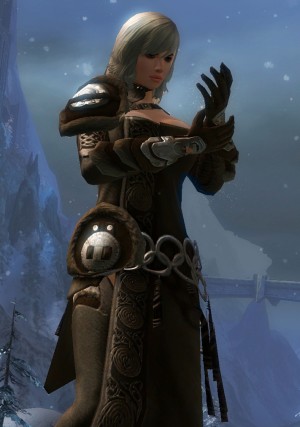
“Crap, what was going on in this zone again? Did I have events to complete in the north? I knew I should have written all this down.”
I couldn’t tell you exactly why – something in the water, I’d guess – but MMO fans seem to love two things. The first is proclaiming that MMOs are suffering from a massive design rut, which is something I can hardly disagree with. The second, however, is determining exactly what will fix everything and usher us into a new age of magic and unicorns. I mean, different sorts of unicorns. We already have some unicorns.
Currently, the savior of MMOs is generally assumed to be dynamic content, a word that’s thrown around with a great deal of vigor as the solution for bland, repetitive questing gameplay. Instead of going to quest hubs and being told what to do, you’ll just see what’s going on around you and take part in events without being told! Immersion will be preserved, and the game experience will be ever-changing, like a real dynamic world. It’ll all be so beautiful, especially if you listen to the marketing folks from RIFT and Guild Wars 2.
Unfortunately, the odds of dynamic content actually accomplishing these lofty goals is another matter altogether. I don’t think dynamic content is actually going to be what designers and players are hoping it will be, for a number of reasons.
Slay and Pray

Turn two, your opponent removes a third of your hand and cripples you. Good game!
One of the potential items you can unlock in Dragon Age II (I promise, this is not another travelogue entry) is the belt Hindsight, a rather clever item that (in-universe) evolves protection that would have saved its master after its master has died. Among its traits is an effect that makes enemies drop better loot when killed – and that got me thinking about the absurdity of our current loot model. Which, of course, brought to mind Magic: the Gathering.
The powers that be over at Wizards spend a lot of time testing mechanics. One of the things that they tested extensively was the use of random mechanics, especially with discards – they wanted to see what felt fair and what didn’t. For those unfamiliar, back in the day there were two flavors of cards forcing you to discard from your hand, one where the cards were chosen by your opponent and one where you threw out cards at random. Both were seen as being intensely valuable, and for good reason – shutting out your opponent’s hand can net you a huge long-term advantage, especially if you start smashing it early.
I’m Ready, Sony Isn’t

“Lenny, you failed me.” “But Grandpa, Fairsley lied!” “Ah, shut up.”
Chris has an excellent post about what the new PS3 hack means for people who have any interest in playing games online on the console with something resembling a level playing field. Here’s the brief summary: sucks to be you.
It’s disappointing, but also unsurprising in a strange way. Sony’s entry in this generation of console interplay has been underwhelming, by which I mean that they have royally screwed themselves to the point where most companies would find a convenient scapegoat in upper management and start warming up the Sacrifice-o-Mat. To the best of my knowledge, this hasn’t happened yet, so I can only assume Sony has somehow managed to screw that up as well.
 Recent Work
- An error has occurred; the feed is probably down. Try again later.
Chocobo Dash
- An error has occurred; the feed is probably down. Try again later.
 Eliot Lefebvre