Demo Driver 8: Serious Sam HD: The First Encounter (#94)
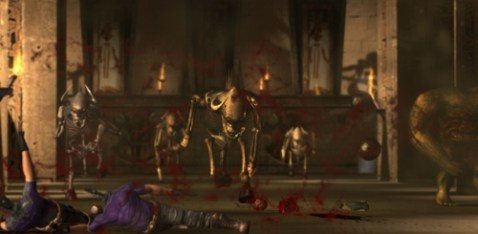
There’s not a whole lot to say, although it’s kind of disheartening just the same.
If you know what Serious Sam is, this delivers exactly what it says on the tin. Whether or not this is a good thing is going to depend a lot upon whether or not you like what the tin says it is.
Serious Sam is a series I was never particularly interested in because, as has been stated many times, first-person shooters are not really my bag. That being said, it’s a series that has long been about distilling shooters down to their most basic objectives. Here you are, and in front of you there is a room. You will shoot people in that room. No fancy tricks, just a whole lot of guns and a whole lot of shooting.
There’s nothing wrong with that sort of bare-bones approach. There was nothing wrong with it back in 2001, when the original game was released; there was nothing wrong with it in 2009, when the HD remake was released; there’s nothing wrong with it now. But it’s a bit like rebuilding a Model T – functional, but something that has kind of been made obsolete by time and technology.
Challenge Accepted: Select difficulty

This is not the vacation I had been expecting.
A curious thing happened on one of my playthroughs of Zone of the Enders: The 2nd Runner. I realized that the difficulty I had things set on was actually making my life harder, despite the fact that it was down at Easy.
I’d beaten the game before, and this was just meant as a fun run using the relentlessly overpowered final form that can then be used to play through the game. What made things difficult is that there’s a boss where your goal is to parry her attacks, then grab her machine and delete a virus that’s manipulating her controls. Hack at her actual mech too many times and it’s game over. Between the difficulty setting and my machine, every time I would accidentally hit her instead of parrying her attack, she’d lose a good third of her health – compared to a normal playthrough, where a few misses were unfortunate, but you had to be really trying to kill her.
This was an isolated incident, but it also serves as an interesting introduction to how difficulty levels alter games, sometimes unsuccessfully. While the dream of multiple difficulty levels is that the same content can provide entertainment for different sorts of players, in practice it doesn’t often work out that way.
The Final Fantasy Project: Final Fantasy IV, part 1
Artwork from a sketch by Yoshitaka Amano
There’s no game in the series that’s had a more tortured path coming over to non-Japanese markets than Final Fantasy III, but Final Fantasy IV certainly deserves a nod, especially as it’s the subject of a lot of rumors and aspersions that simply aren’t true. Everyone knows that it was released as Final Fantasy II originally, that the version released in the US was easier than the one released in Japan four months earlier, that a lot of it was censored… you get the idea. And, unfortunately, even with the ability to clear up a lot of misconceptions now, they persist just the same.
Let’s start at the beginning. Final Fantasy IV started development after Final Fantasy III‘s release simultaneously with Final Fantasy V… sort of. Square was working on two titles for the two Nintendo consoles: Final Fantasy IV for the Famicom, Final Fantasy V for the Super Famicom. Limitations of resources meant that the idea of another Famicom game was scrapped, and instead all of the resources were brought over to the retitled Final Fantasy IV. The Famicom game was apparently about 80% done and some elements were supposedly reused, but it’s never been stated what, exactly, got reused. (I have speculations, but that can come later.)
Demo Driver 8: Blade Kitten (#353)
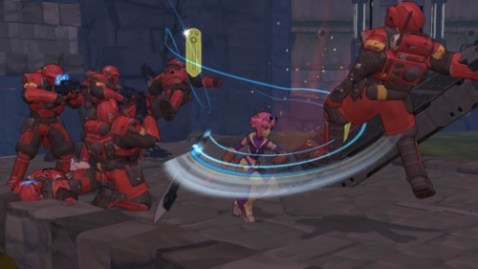
It’s nice when something turns out better than you had any expectations it would be, definitely.
While I like Steam’s integration of Metacritic into its client, sometimes that can sort of send up red flags right away. Blade Kitten‘s aggregate score of 52 certainly didn’t do it any favors. But that’s the most straightforward part here.
Blade Kitten is a side-scrolling platformer based off of a comic… or it’s a platformer that also has a comic… or some combination thereof. I’m not clear on the exact timeline. What I am clear on is that Krome Studios employed the artist as creative director, launched the game with Atari, then got caught up in Atari’s slow-motion self-destruction and had to wait for a long while to get the rights back for the game, which apparently kind of killed the comic, too? There hasn’t been an update there since 2012.
All that backstory aside, the game is now back in the hands of Krome Studios, but with a dismal review score. Is it any good? Does it deserve that score? What did it do to garner such vigorous fans other than having a pink-haired catgirl as the main character? Actually, the last one might answer its own question.
The Final Fantasy Project: Final Fantasy’s first generation
Artwork from a sketch by Yoshitaka Amano
You know what I really wish the end of Final Fantasy III signified? That I could move off of my PSP. Sure, I love the system, but I’d really like to be playing these games in a format that allows for proper screenshots. Alas, the rules I’ve laid out keep me on this handheld through Final Fantasy IV and points related, not that things get much better once I move on to Final Fantasy V.
What it actually symbolizes, however, is that I’ve finished up the last game in the franchise that appeared on the NES, or the Famicom if you’d prefer. All three editions are remakes, yes, but the original games started life in the 8-bit era. It’s an interesting element that’s easy to overlook in favor of strict linear progression, but I think it has important implications and information about the franchise as a whole. Yes, in some ways the hardware was just that – hardware, the stuff powerful enough to run these games. But it also has implications for breaking up the flow of the series and how it’s evolved over time.
 Recent Work
- World of Warcraft kicks off Season 1 of Midnight along with its newest charity pet
- Final Fantasy XIV celebrates Hatching-Tide once more starting on March 23
- Subnautica 2 lawsuit chancellor orders Krafton to reinstate OG Unknown Worlds boss Ted Gill
- Prism 2033 is a new open-world MMORPG making big promises – and flashing some AI
- Wisdom of Nym: What we learned about Final Fantasy XIV’s next patch from the first live letter
- The Daily Grind: What’s your dream expansion for an MMORPG you’re never getting?
- WRUP: Prisoner of the heck fart brigade edition
- Betawatch: Shadowstone kicks off playtesting, EVE Frontier plods onward
- PSA: The Elder Scrolls Online is giving tons of free stuff to players through May 12
- Storyboard: The challenges of breaking into a calcified MMORPG roleplaying community
Chocobo Dash
- An error has occurred; the feed is probably down. Try again later.
 Eliot Lefebvre