Sequel ties
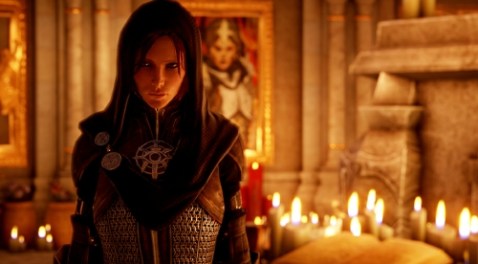
The fact that she could theoretically be dead is apparently something people have a great deal of investment in.
In the earliest days of video games, it was very easy to understand how sequels to a game would work. You had a title, then you had a number after that title. Maybe a subtitle if you were feeling fancy. Once you loaded up that sequel, you were starting back from the same position as someone who had never played the predecessor, because of course you were. That was just how it worked. There’s a reason why early series either had stories that were only loosely connected by theme (Final Fantasy or Ultima, for example), protagonists who had reason not to carry things over from prior titles (Metal Gear), or were produced by companies that don’t care about your stupid continuity (Every Capcom Game Ever).
We are no longer in those earliest days now, though. In order to properly play Dragon Age: Inquisition, I had to log into an external website and recount all of the things I had done during my playthroughs of Dragon Age: Origins and Dragon Age II to ensure that the world was still one I recognized. And that’s worth discussing, because if you think about it that’s both kind of strange and kind of brilliant.
The Final Fantasy Project: Final Fantasy IV: The After Years, part 10

Artwork from a sketch by Yoshitaka Amano
All right, people, let’s talk about villains.
Redeeming a villain is at once the best and worst thing you can do to them. It’s super tempting, obviously, because when written well a villain is easily one of the most fascinating characters in a story. So now you get one of the most interesting characters in the story as someone the audience can actually cheer for, which is why the temptation arises. Yet a redeemed villain has to be different than their original villainous incarnation, often meaning that they set aside the cool stuff that made them likable in the first place.
Yes, it can be done; Emma Frost was a prime example of taking a villainous character and making her a protagonist with good aims rather than necessarily a hero in her early days (that’s kind of been undone with years of character decay). It just doesn’t happen frequently. I bring all of that up because The After Years is wandering into that territory now, and given the game’s narrative chops and track record up to this point, you will hopefully forgive me if I don’t have the utmost confidence in the game’s ability to do a complex concept justice.
Telling Stories: I’m not calling you a liar
 If you’ve never played Dragon Age II, you missed out on some great lying. The whole story is told with the framing device of Varric Tethras being interrogated, and his interrogator knows full well that Varric is a liar. What she has to do is sort out which parts are outright lies, which parts are exaggerations, and which bits are the truth.
This, I think, is the goal of pretty much everyone who roleplays a duplicitous character. And it’s hard to get to that point, because you need to be a liar who’s just trustworthy enough that no one knows where the lies start and the truth begins. It’s forever a fuzzy line, and while no one can quite trust your character they also can’t discard the possibility…
It’s hard to reach that point, though. Much more often, you just wind up with a character who no one trusts and quite possibly isn’t a whole lot of fun to play. So how do you make a better liar? How do you make a character where everyone knows they’re lying, but everyone still wants to hear what they have to say?
The Final Fantasy Project: Final Fantasy IV: The After Years, part 9
Artwork from a sketch by Yoshitaka Amano
Time to start going all in, then.
The short version of the flow of the game is that the first seven tales pretty much take place at the same time, following characters hither and yon in a bunch of events that tie together thematically but not in narrative. This, then, is when everything starts getting explained. It’s an interesting approach, which saves the trouble of having a big twist partway through the story but replaces it with a set of mysteries that players can either figure out early or get bored with reading about for the tenth time.
I’ll get more into that once I’m actually done, though. For now, it’s time to jump ahead to the first tale that starts clearing up all of this mess, spearing the events that will take us through the rest of the game. As you could probably guess, that’s a not even remotely subtle reference to the fact that we’re kicking off with Kain, who’s supposed to be a brooding badass but really comes across more as a moping manchild who has serious issues with his spear. That… may both be a little too on-point and unintentionally autobiographical, yes?
Marlow Briggs and the God of War
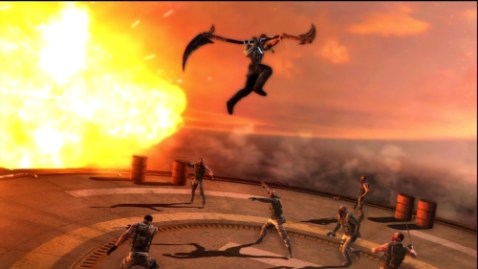
I don’t know about you, but I find this a lot more believable than having your superpowered hero come from a culture which was famous for its military discipline and unit organization.
It took me about six hours, start to finish, to get through Marlow Briggs and the Mask of Death. Considering that I was playing it at the same time as Final Fantasy IV: The After Years and my usual Final Fantasy XIV shenanigans, it took me a few days of real time, but it is not a particularly bulky game. Not that you’d expect a whole lot from a game that costs you a grand total of five dollars.
But I’m pretty sure I had as much fun with it as games that cost me ten times as much.
In a just world, this would have been the first game of a series that would predate God of War, because I’d much rather be playing the seventh installment of Marlow’s adventure than watching Kratos grimace through a field of inexplicable tits and sneering white guy violence. Alas, we don’t live in that world, we live in this one. But comparing the two is telling, because it’s one of those times when a much cheaper game manages to do everything a more expensive equivalent does with equal panache – and often with traits that the “bigger” title lacks altogether.
 Recent Work
- An error has occurred; the feed is probably down. Try again later.
Chocobo Dash
- An error has occurred; the feed is probably down. Try again later.
 Eliot Lefebvre