The Final Fantasy Project: Final Fantasy III, part 1

Artwork from a sketch by Yoshitaka Amano
Final Fantasy III is why this project is what it is.
We’re now entirely out of the realm of repeats from stuff I’ve written before; everything going down in these columns is totally live, so I’m not yet sure how long we’ll be exploring the world of whatever-planet-this-game-takes-place-upon. But we’re doing so on the note of exploring a game that had, easily, the most convoluted trip across the waters of any title in the Final Fantasy franchise. Which is a little weird when you consider that it more or less finished the foundational work started by Final Fantasy and Final Fantasy II.
See, Final Fantasy III never came out in America. Sure, Final Fantasy II took a long time to come over in the form of Final Fantasy Origins, but that version of the game was a strict graphical update and the mechanics were identical. The original form of Final Fantasy III, however, has never been released – and at this point, odds are low that it ever will be, because the remake sort of has two sequels and is the general port of call. I told you this was convoluted.
Demo Driver 8: Alien Rage (#85)

Four unlikable protagonists rolled into one! How can you lose?
The first installment I did of this feature was about Alien Breed 2: Assault. I wouldn’t say I critiqued that game harshly for being generic, but the acknowledgement was there. Yet for all that, the nature of it didn’t make the game bad. It was what it was, and it certainly would win no prizes for originality, but I try hard to point out that there’s a distinct difference between games that scratch an itch I don’t care for (DRIVE ’07, Eschalon Book 1), games that are generic but solid (Alien Breed 2: Assault), and games that are actually not very good.
I bring this up because Alien Rage is sipping from the same well as Alien Breed 2: Assault, but where the former feels kind of bland but eminently playable and solid, Alien Rage is a game that made me lose interest before I had even gotten to shooting anything. I almost wish I had stopped there, because I knew it wasn’t going to get better, but in the words of Macbeth, bear-like I fought the course. It is a game best used as an object lesson about why “generic” doesn’t mean “bad” but it certainly doesn’t mean good either.
The Final Fantasy Project: Final Fantasy II, part 7

Artwork from a sketch by Yoshitaka Amano
Finally, the endgame. It’s refreshing, in a way. There are no more plot holes to nitpick, no more fetch quests to be sent on, nothing but several floors of dungeon between the main characters and the final boss. Through the Jade Passage, into Pandaemonium, and then up against the Emperor.
Again. I mean, I killed him once, so it doesn’t seem like he’d be able to get harder this time around based on the fact that he couldn’t stop me while he was alive, but I guess Hell was waiting for him or something? I suppose we can mark him under the long line of Final Fantasy bosses with plot armor and plot skill absorption.
Of course, the game is going to do its level best to go out like it came in: with thunderously irritating and ill-conceived mechanics. First, the Jade Passage, which is one of only two things that you actually travel to via the airship. Once inside, you’re in the endgame for good. There’s no getting out, so you’d better have everything you need on hand.
A virtual gun and good entertainment (or why you still need to play Spec Ops: The Line)
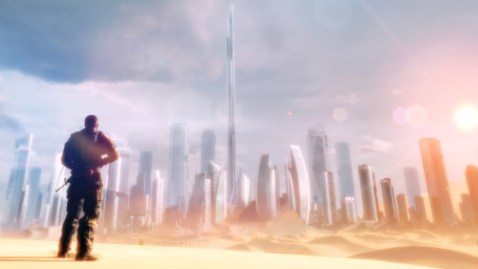
The heavenward spire never looked so foreboding.
There’s something unsettling in playing Spec Ops: The Line, long before its major twist really falls upon you. Oh, sure, it plays like a conventional third-person shooter as you storm along and gleefully pull the trigger on your gun, but right from the start there’s something unsettling therein, something that gnaws at you. The environments are too claustrophobic, the dialogue too close to the edge of snapping and growling, every moment too pitched and agitated for what’s going on. Sudden slowdowns punctuate combat as you kill people, seemingly without reason, the camera and the events around you drifting slower as if to give you just enough time to really think about the life you ended.
Of course, at this point you don’t need me to tell you what the deal is with the game. It’s been raved about critically, praised as a deconstruction of the real-is-brown military gun-porn shooter by more or less every outlet in existence. Sales weren’t what they could have been, but it succeeded at its goal. But how much merit does it still have? When you know the gut punch that it’s aiming for you, is it still as effective? Does the game still have a point when the only audience that’s going to remember it is the audience that has the least need of it?
Telling Stories: Fitting in the circle
 I was introduced to the idea of character circles a long time ago, in an essay about writing Transformers fanfic of all the things in the world. Needless to say, that’s not my usual go-to source for writing advice or roleplaying advice, but it’s still a good idea, and it’s one that I’ve internalized over the years as being extremely useful for both. Especially if you’re dealing with characters who change a lot over time.
Let’s be honest and admit that characters in roleplaying can be somewhat… fickle. They’re probably being consistently played by one person, yes, but your moods change, circumstances change, and what seemed like a perfectly good idea with your character yesterday doesn’t seem like one today. Over time, you get a feel for what your character will or will not do, but that doesn’t change the fact that sometimes you just make a call and it might be almost entirely arbitrary. What you need to describe your characters isn’t a biographic listing of characteristics; what you need is a circle.
 Recent Work
- An error has occurred; the feed is probably down. Try again later.
Chocobo Dash
- An error has occurred; the feed is probably down. Try again later.
 Eliot Lefebvre