Challenge Accepted: Selling on the challenge
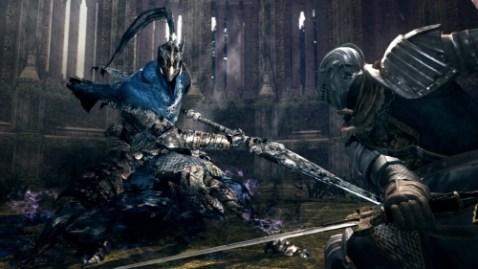
Yeah, this is going to get worse before it gets better, isn’t it?
Dark Souls doesn’t beat around the bush when it comes to difficulty. You will die in this game. You will die over and over, brutally, ripped to shreds by enemies that are there for the explicit purpose of ripping you to shreds. The PC version is subtitled as the Prepare to Die Edition, a not-so-subtle reminder that when you start playing this game death comes for you on swift wings. And swift legs. And swift fins. Basically, everything is going to kill you over and over and you’re going to like it.
Is that challenging?
I’m not asking if the game is really all that hard or not, that’s for reviewers to argue over. (Or, as is more frequently the case, for forum-goers to debate with “oh, it wasn’t that hard” substituting as the gaming equivalent of explaining how many one-armed pushups you can do in an hour.) Rather, it’s a question of how challenging a game can be when its entire purpose is stated right from the start, when you walk in with a solid promise that this game will kill you over and over. Are you getting a challenge, or are you just getting what you paid for?
The Final Fantasy Project: Final Fantasy II, part 4
Artwork from a sketch by Yoshitaka Amano
At roughly the halfway point of the game, Final Fantasy II has kind of worn out its welcome. This would not be as big of a deal if there was less game left to go.
Part of the problem here is that it doesn’t take many cues from Final Fantasy where perhaps it should. There are parts of the original that I accused of being a slog, and they certainly were, but at least every part of the game made a genuine effort to reward you in some way. Yes, the dungeons could turn into slogs, but at least the enemies rewarded you with experience instead of tedium.
The encounter rate is absurdly high, but the ambush rate is also absurd, leading to a multitude of turns spent watching enemies act and then act again. This includes several enemies with annoying but not actively dangerous special abilities that bog combat down even further, making themselves priority targets just so I won’t have to wait through their animations again. It’s the worst kind of battle where it would take a seriously bad day for you to lose, but you still have to wait to win, like playing against someone in Magic: the Gathering who keeps adding more life without any way to hurt you. Sure, it takes you longer to eat through the wall of health, but who cares?
But I think there’s an even more important element here, and that’s the simple fact that my tactical options are pretty much zero.
No, I don’t like Star Wars
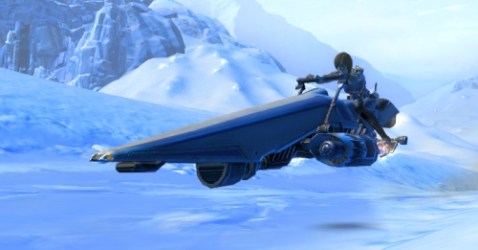
It’s Hoth. It’s always Hoth. Because it was in the movies, and how can we possibly avoid referencing the movies over and over? So let’s slowly erode the idea that Hoth was this frozen backwater in the middle of nowhere and just keep going back to Hoth. (And somehow it’s still doing better in this regard than Tatooine.)
One of those things that always sticks in my craw is the result when I mention around people I don’t know that I don’t like Star Wars. Because someone always doesn’t believe me.
There’s a little twitch in the eye, a stare, an odd expression. “Really?” they ask. “Not even such-and-such? Does that mean you don’t like this or that?” It’s a request for elaboration, like there has to be some caveat, it can’t be as simple as just the fact that I would be much happier to live in a world where there would be no more Star Wars.
What I do like that intersects with Star Wars is a very thin list that I generally enjoy in spite of its association, not as a result of it. I would much prefer if Star Wars: The Old Republic was based on literally any other property in the world. I have to consciously distance myself from the name when I attempt to enjoy the original trilogy. I don’t like Star Wars, and I think there’s a lot of good reason not to like Star Wars.
Demo Driver 8: Trine (#212)
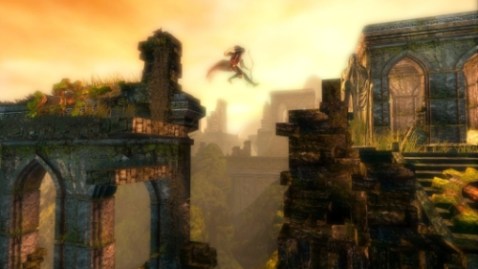
The thief, to almost no one’s surprise, is my favorite.
It seems really odd to me that for all of the things that Blizzard Entertainment has done over the years, we’ve never gotten any sort of further development of The Lost Vikings. Maybe not necessarily in the same setting – I wouldn’t be surprised if the Interplay thing has tied up publishing rights or whatever – but it seems like something natural to update, you know? There’s a market for this sort of puzzle game, and as much as Blizzard has earned its reputation over the past few years as an obstinate behemoth, it’d be a good way to remind everyone just how clever the company can be.
Not that the concept hasn’t been explored in other places. I bring all of this up because today’s demo, Trine, explores the same fundamental conceit. To wit: you are placed in control of three different characters with three different sets of abilities, and it’s up to you as the player to guide all three of them through a level. It masquerades as a platform game, but this is a puzzle game, as surely as Portal 2 or Tetris or Braid.
Telling Stories: Tomato, Tomato, Shield Bash, Arm Thrust

How many classes are there in World of Warcraft?
If you said “eleven,” then you are wrong. But you’re doing good, that’s the number listed, you’re wrong with the best intentions. If you said “thirty-four,” you are also wrong, but you are very astute, noting that the choice of specs now is functionally like choosing a class. (Albeit ones you can swap back and forth between.) If you said “seventeen” then… er… you may wish to take some issues up with your elementary school teachers, that’s not even close to anything resembling a correct answer. But thanks for coming out.
No, the correct answer is “as many as you want there to be.” And the same is true of literally any game with classes or abilities. You’re only as limited as you allow yourself to be. You see a list of options and you group characters into small cliques, assuming that everyone who possesses these same skills must be the same sort of person… but that’s you talking, not the game. Not the game at all.
 Recent Work
- An error has occurred; the feed is probably down. Try again later.
Chocobo Dash
- An error has occurred; the feed is probably down. Try again later.
 Eliot Lefebvre