Challenge Accepted: The virtues of easy
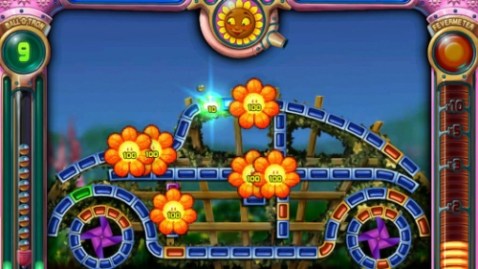
Why play this instead of something harder? I can think of dozens of reasons.
If you can’t understand why someone would want to play an easy game, I don’t think you understand why people play video games at all. I’m not saying you have to want to play one, I’m saying you have to understand why someone will do that. No, saying “because they can’t play well enough to be at the top” does not qualify as understanding.
I like talking about challenge in games – a lot – but I also can’t stand the chest-pounding portion of the general gaming audience who seems to collectively believe that if you’re not turning every game into an arduous challenge then you’re obviously unworthy of purchasing any more games over the course of your life. As if there was no way to enjoy a game that tried just being easy, as if there was nothing to be derived from a game that’s not terribly deep, as if there was no modulation or middle ground between people who enjoy challenges and those that enjoy challenges. Or, for that matter, as if every game wasn’t easy in the right light.
Spoiler warning: all of the above are true.
Challenge Accepted: Selling on the challenge
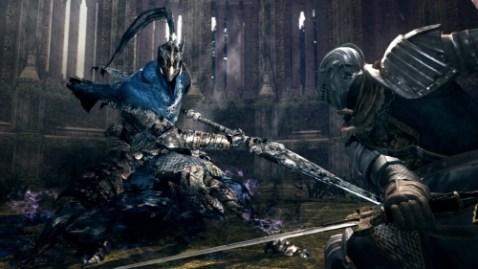
Yeah, this is going to get worse before it gets better, isn’t it?
Dark Souls doesn’t beat around the bush when it comes to difficulty. You will die in this game. You will die over and over, brutally, ripped to shreds by enemies that are there for the explicit purpose of ripping you to shreds. The PC version is subtitled as the Prepare to Die Edition, a not-so-subtle reminder that when you start playing this game death comes for you on swift wings. And swift legs. And swift fins. Basically, everything is going to kill you over and over and you’re going to like it.
Is that challenging?
I’m not asking if the game is really all that hard or not, that’s for reviewers to argue over. (Or, as is more frequently the case, for forum-goers to debate with “oh, it wasn’t that hard” substituting as the gaming equivalent of explaining how many one-armed pushups you can do in an hour.) Rather, it’s a question of how challenging a game can be when its entire purpose is stated right from the start, when you walk in with a solid promise that this game will kill you over and over. Are you getting a challenge, or are you just getting what you paid for?
Challenge Accepted: That’s not a challenge

I hate to make it seem as if I’m kicking a game on the way out, but if there was ever a poster child for some of this…
I probably don’t need to tell you about fake difficulty; we all know what that is by now. It’s one of those concepts that’s been held over in design for years now, a crutch that games use both unintentionally and intentionally. Forcing you to sneak past rows of enemies you could dispatch in moments is an intentional use of it, a game that just isn’t coded very well and winds up with difficult controls that hamper your experience has sort of stumbled onto it. You might think this article was meant to be about that.
It’s not.
While we all know about the telltale markers of fake difficulty, we don’t talk much about the elements of challenge that don’t actually qualify as challenge. These aren’t relentlessly cheap, but they’re also not really something that’s hard to do so much as they’re bulking out actual challenges with filler. If difficulty is meat and fake difficulty is something vile substituted for meat (tofu, maybe, since I don’t like tofu), these are water. You can inject a bunch into anything and fill out the size, but the actual content remains about the same.
Challenge Accepted: How games challenge you

Sometimes it’s just challenging to keep your feet underneath you.
Consider a simple game for a moment. Your objective is to tap a key as fast as you possibly can, let’s say the letter X. Every time you hit the key, your score goes up by one. If you stop hitting the key for five seconds, your game ends. Now let’s consider another equivalent game with a different end condition: if you don’t alternate between X and C, your game ends, although you can take as long as you like between presses.
Both games are functional, both offer a challenge, and both could be dressed up to provide a sense of opposition. (Although sometimes all we need is a Flash interface telling us to hammer on the X key to waste two hours of an idle afternoon.) But this isn’t the same game repeated. There’s a different challenge in both versions. In one, it’s all about speed; in the other, it’s memorization. If you’re going to think about challenge, you have to think about more than just the existence of same and more of the types that can be faced.
Challenge Accepted: The need for opposition

If games require challenge, why is this still obviously a game?
Defining games is difficult. Yes, despite what one or two people like to claim in every debate on the matter. You can argue a dictionary definition, but you can use the same damn argument to claim that the only real game is animals being hunted for food. If it were simple to figure out what makes a game, there wouldn’t be any discussion on the matter in the first place. (Spoiler warning: there is a lot of discussion, constantly.)
One thing we do agree upon is that there’s a need for some kind of obstacle. A game isn’t really a game if it doesn’t give you a goal and then offer you impediments to that goal. It’s at work in the very beginning of Super Mario Bros. Your goal is to reach the far right side of the level, but there are enemies and obstacles in the way which can kill you and prevent you from achieving that goal. It all seems very simple on paper.
But it’s not really that straightforward. Very few things are.
 Recent Work
- An error has occurred; the feed is probably down. Try again later.
Chocobo Dash
- An error has occurred; the feed is probably down. Try again later.
 Eliot Lefebvre