Challenge Accepted: That’s not a challenge

I hate to make it seem as if I’m kicking a game on the way out, but if there was ever a poster child for some of this…
I probably don’t need to tell you about fake difficulty; we all know what that is by now. It’s one of those concepts that’s been held over in design for years now, a crutch that games use both unintentionally and intentionally. Forcing you to sneak past rows of enemies you could dispatch in moments is an intentional use of it, a game that just isn’t coded very well and winds up with difficult controls that hamper your experience has sort of stumbled onto it. You might think this article was meant to be about that.
It’s not.
While we all know about the telltale markers of fake difficulty, we don’t talk much about the elements of challenge that don’t actually qualify as challenge. These aren’t relentlessly cheap, but they’re also not really something that’s hard to do so much as they’re bulking out actual challenges with filler. If difficulty is meat and fake difficulty is something vile substituted for meat (tofu, maybe, since I don’t like tofu), these are water. You can inject a bunch into anything and fill out the size, but the actual content remains about the same.
The Final Fantasy Project: Final Fantasy II, part 2
Artwork from a sketch by Yoshitaka Amano
One of the biggest things I noted about Final Fantasy is that its open world is really an illusion. You’re carefully sectioned off into very limited exploration, with the game always forcing you into the right parts simply through a dearth of alternatives. You can see this as a failing, but you can also see it as a notable advantage. It’s possible to be a bit unsure of where to go next, but you can always fall back on exploring for a while with the knowledge that you’ll stumble on your objective eventually, simply because there’s nowhere else new to go.
Final Fantasy II is a bit worse about that. The world is more open, and you have more chances to go off the rails. Which means that you get more opportunities to exercise your freedom, but it also means that you find yourself more likely to be unsure of where to go next in a game that doesn’t even provide you with helpful pointers like levels. And the second major quest in the game kind of leads in that direction, because your destination is sort of hidden way the heck and gone.
Demo Driver 8: Pyroblazer (#284)
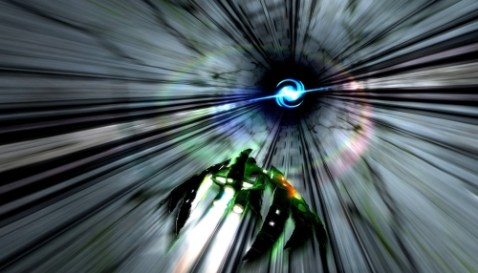
Your guess is as good as mine right now.
Sometimes you get a very clear picture of a game from a demo because the demo is well-constructed, offers you enough of the game to know what it’s on about, and leaves you wanting more. Honestly, most of the demos I’ve reviewed here have accomplished that goal rather nicely. I’ve no desire whatsoever to play RACE 07, but I have a reasonably clear picture of what the game is from the demo and feel as if everything it wanted to accomplish was laid out clearly.
Sometimes, though, the demo – and possibly the entire game – is a confused mess that gives you such a top-level overview that you’re not sure what in the world is going on, let alone how the game is supposed to tie into anything or be relevant. And that, I’m sorry to say, is what I was left with after my brief time in the Pyroblazer demo. The whole thing comes across as a big blending of various elements without further explanation, and by the time I was done I was just plain tired.
Telling Stories: With my weapon

Let’s kick this column off with a rhetorical question. Why did Final Fantasy XIV and WildStar both tie character classes to iconic weapons?
You could say it’s for ease of itemization, or for transparency in play, but I think the real reason is much simpler: weapons say something. We associate certain traits with weapons. They’re not just tools, they’re symbols, part of the language by which we understand our characters and their capabilities. An entirely different message is conveyed if your character is wearing a sword or a gun on his hip, after all. Human beings (and, presumably, almost-human beings) have an attachment to our weaponry.
This is a rich vein in fiction, of course, and most games go the extra mile by having several weapons with names and points of origin. World of Warcraft is awash in notable weapons, Final Fantasy XIV has Relic Weapons, Final Fantasy XI has Mythic Weapons, Guild Wars 2 has Legendaries, Lord of the Rings Online even lets you raise a weapon as a specific legendary item. It’s a fertile ground for roleplaying, and it’s well worth exploring what it could mean to have a special weapon or two… even if those weapons aren’t useful because of their power.
The Final Fantasy Project: Final Fantasy II, part 1
Artwork from a sketch by Yoshitaka Amano
Final Fantasy II is not nearly as well-known as its predecessor. Which is not surprising, considering that it took fifteen years to reach US shores and is also horribly broken. We’re talking about a table that comes with a leg on fire levels of broken here. It’s the origin of large parts of the franchise, but it wound up being kind of forgettable in the overall progression.
But you can’t blame all of that on the game itself. The lack of a US localization is mostly Square’s fault as a company, since the folks in charger were certain that the first game in the series wouldn’t sell and didn’t bother to localize Final Fantasy I until three years after it was released in Japan. It did sell quite well, naturally, at which point a hasty localization project began for FFII… which fell apart when someone had the bright idea of just translating the then-contemporary Final Fantasy IV. And quite frankly, translating all of the text in the game was a pretty big chore anyway.
 Recent Work
- An error has occurred; the feed is probably down. Try again later.
Chocobo Dash
- An error has occurred; the feed is probably down. Try again later.
 Eliot Lefebvre