Mangling terms

Sometimes, admittedly, it’s not necessary to call a game a clone to get an idea of how it plays.
Remember when “clone” wasn’t a term of scorn when discussing a video game?
When people first started saying thing like “Saints Row is a clone of Grand Theft Auto III,” it was actually conveying useful information. Considering the sheer number of games available and the tendency for a new game to closely emulate previous games with a few changes, “X-clone” can often be more descriptive than a simple genre listing. Sure, both New Super Mario Bros. and Sonic the Hedgehog 4 are side-scrolling platformers, but saying that a game is a clone of New Super Mario Bros. provides far more relevant information about how the game plays.
Not that it matters any more, because if you call something a clone of another game, the implication is that it’s a bad game. Because calling things clones has fallen victim to an odd part of discussing games, where we as a culture somehow manage to create and then destroy the terminology we would use to discuss this stuff. It happens everywhere given time, but when it comes to game our new terminology seems to have a half-life of ten minutes before it becomes totally useless.
Demo Driver 8: Among the Sleep
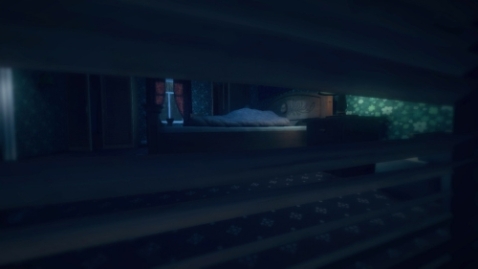
Standing here, with sounds coming through the house, not sure where your mother is, the world too dark to make out details… that’s scary.
At a glance, Among the Sleep is two different games, one of which is brilliant and one of which isn’t. Which is especially interesting as one of the games is only a game by the thinnest stretch of the imagination, and yet it’s the one I found more interesting; the demo lost me when it started inserting a bit more gameplay, which merited far less attention in general.
The premise of Among the Sleep strikes you as novel right from the start. Your character is a two-year-old child, and it’s played from the first-person perspective. And it’s a horror game. More than that, it’s a horror game of the sort that you become immediately familiar with mere seconds after you start up the demo. It is dark, you are young, and you are alone. Bad enough in and of itself, but then your crib tilts over, you hear a crash from downstairs… and you can get out. To find your mother.
Telling Stories: I wish I was
 At its most basic level, all roleplaying is a form of wish fulfillment. Sure, you may not want to be your characters, but you presumably enjoy slipping into their heads for a little while. It’s a chance to step out of yourself and engage in behavior you never would in a normal setting, whether that behavior is something you’d personally find reprehensible or just something different from the norm. (Slaying monsters, for example, does not form the foundation of a solid career path in modern society. I’ve checked.)
That doesn’t mean it’s always a good thing.
Wish fulfillment is a tricky thing to discuss when it comes to roleplaying precisely because it’s always there, even if it’s usually a background issue. You can’t pretend it has nothing to do with your characters, but you also don’t want them to be nothing more than pure self-serving fantasy engines. So let’s talk a little bit about wish fulfillment in games, how it works, what you can get out of it, and how you can avoid making your characters into the gross sort of wish avatars.
Uniquely game-based horror
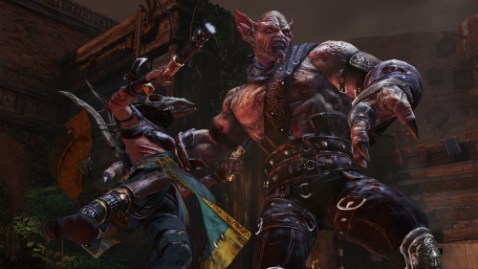
No, I’m not quite talking about the horror inherent in realizing that this is probably both the revival and the end of the Legacy of Kain franchise.
Video games have a lot of potential for horror that I don’t think we’re tapping into. I’m not just talking about transparent crap like marketing games with zombies as “survival horror” so much as obvious avenues of game design that just don’t get tapped. And part of that is preying upon the sorts of horror that don’t exist outside of video games.
Unlike most forms of horror, video games have a requirement for audience participation. You don’t watch games, you play them. There are certain tricks that implies which just can’t be pulled off when you have an entire audience sitting and watching. There are ways to make games feel more horrifying that really lean on the fact that these are games, that players are playing them, that you can hit a sense of powerlessness for the players at a more primal level. There’s stuff that’s scary without requiring big claws or teeth or any combination thereof.
So let’s talk scary, and let’s see how games can really screw with the heads of players with some simple (and kind of horrible) tricks.
Demo Driver 8: Tobe’s Vertical Adventure
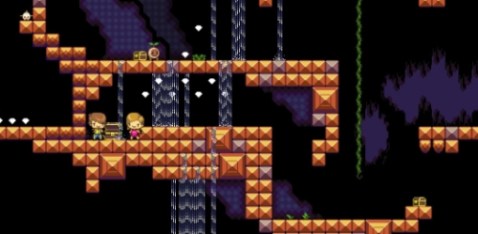
Nostalgia coupled with nostalgia married to solid mechanics leaves evaluations in a complicated place.
I may be alone in this regard, and by “may be” I mean “certainly appear to be,” but I am entirely done with the current waves of misguided affection for the arcade games and early 16-bit games that I had in my youth.
This is not to say that the indie love affair with old-school games is an inherent hindrance any more than the triple-A fascination with fabric simulation is an inherent hindrance; it’s more that both tend to produce a lot of stuff that starts with a bedrock of nostalgia and never quite gets around to assembling compelling gameplay to support it. Instead, there are games – which you can probably guess include today’s offering – which are perfectly serviceable homages without adding much on besides.
Fortunately for Tobe’s Vertical Adventure, the game is more aiming at a feel than a particular game or style, which covers a multitude of sins. It’s not a bad game, either, but it certainly feels like the homage cam first and the actual gameplay showed up late to the party without appropriate clothing. So it manages all right, but it never quite manages to pass that threshold of being good enough that there’s no reason to care about visuals.
 Recent Work
- An error has occurred; the feed is probably down. Try again later.
Chocobo Dash
- An error has occurred; the feed is probably down. Try again later.
 Eliot Lefebvre