Telling Stories: You’re not that girl
 Roleplaying is, in part, the act of getting into your character. You kind of have to. Like an actor stepping into a role, you become this character, start understanding how they work and what they want, try to produce a coherent picture of what they’re all about. You want to get to a point where the character’s actions are as natural to you as your own, when you rarely have to think about what your character would do in a given situation because it’s almost entirely self-evident. Which makes it just a little strange when you have to also step back and remember that this character is not any part of you.
Perhaps that’s stretching it – you always invest a bit of yourself in your characters, obviously – but you are still separate. You aren’t the same person. What happens to the player is not dependent upon what happens to the character, and even just speaking from experience there are a lot of things my characters do that I’d never even consider. So let’s talk a little bit about creating that space and pushing back against identifying too much.
Expanding beyond Titanfall’s server limitations
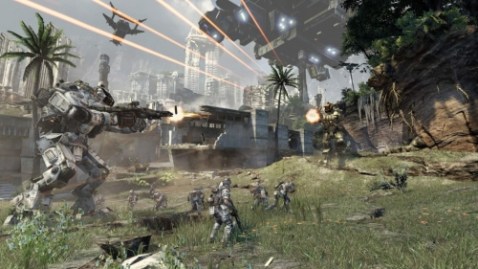
A game about giant robots can now be played almost entirely with robots.
Last week, Titanfall set up what I think is a very fair penalty system. If you are caught cheating, you are not banned, you’re simply banished to a server where everyone else is also a damn cheater. So you will be more than able to enjoy the game, if what genuinely makes the game fun for you is playing amidst a field of cheating bastards.
Incidentally, that was the original title for Sting’s “Fields of Gold,” I believe.
I feel this is an excellent first step, but by no means the final one. This is a brilliant concept that is almost infinitely expandable, allowing companies to ensure that players get to live with the people what will nurture and understand them. Or at least understand them. All right, that’s not really what I’m concerned about so much. There are toxic and vile people on the internet who seem to enjoy spreading vile toxicity into the games that we love, and perhaps we could use this same methodology to deal with people best surrounded by one another in the hopes that they may realize “wow, I am extremely annoying.”
Challenge Accepted: The need for opposition

If games require challenge, why is this still obviously a game?
Defining games is difficult. Yes, despite what one or two people like to claim in every debate on the matter. You can argue a dictionary definition, but you can use the same damn argument to claim that the only real game is animals being hunted for food. If it were simple to figure out what makes a game, there wouldn’t be any discussion on the matter in the first place. (Spoiler warning: there is a lot of discussion, constantly.)
One thing we do agree upon is that there’s a need for some kind of obstacle. A game isn’t really a game if it doesn’t give you a goal and then offer you impediments to that goal. It’s at work in the very beginning of Super Mario Bros. Your goal is to reach the far right side of the level, but there are enemies and obstacles in the way which can kill you and prevent you from achieving that goal. It all seems very simple on paper.
But it’s not really that straightforward. Very few things are.
Genre evolution isn’t up to you
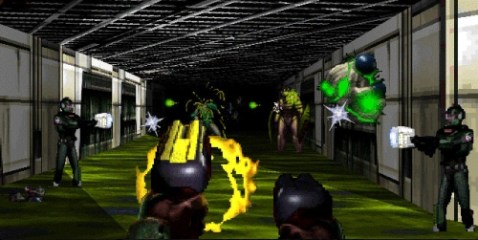
The graphics do not hold up all that well after all this time, but you can’t really expect that.
When I was younger, I played one of my favorite first-person shooters of all time: Marathon. The game was atmospheric as heck, but more than that, it was a departure from what the genre had been up to that point. Rather than being constrained by the claustrophobia of the first-person view, it explored it. The entire game was about you seeing things through a narrow lens, trying to assemble a complete picture from snippets and pieces, and in between you were shooting at a whole lot of aliens who started shooting at you first. It wasn’t even entirely clear who was on your side and who wasn’t at a glance.
I looked forward to the future of the first-person shooters as a result; I had enjoyed Doom despite the constrained viewport, and I thought Marathon was a look in the future. Instead, that future was based on Quake and Unreal Tournament and now Call of Duty or Battlefield or whatever game you’d like to name in which a bunch of gray soldiers shoot another bunch of gray soldiers on a battlefield which is itself gray (and sometimes brown).
Is that a failing of the genre? Nope. That’s just how things go.
 Recent Work
- An error has occurred; the feed is probably down. Try again later.
Chocobo Dash
- An error has occurred; the feed is probably down. Try again later.
 Eliot Lefebvre