Telling Stories: The post-mortem examination

When everything is said and done, that’s when you can take it all apart.
I recently wrapped up some pretty big roleplaying in Final Fantasy XIV. Well, “recently” more in the sense of “within the past month,” but that’s not the point. It was a big storyline with lots of moving parts, the near-death of the main character I’ve been playing for the past four years, and a lot of long-standing character threads finally getting resolved. Not that there aren’t still boatloads of story threads to be picked up, of course, and so as soon as it was over I started running a post-mortem on it.
So why do that instead of get started on the continuation of the story? Because a post-mortem, written or not, is a great way of examining how the whole event went down, even if it’s just from your perspective. The most effective tool in your arsenal when running events is the ability to look at what happened, see what did and did not work, and subsequently understand what could be done to make the next event run that much better.
Challenge Accepted: Difficulty patterns

Giving the player ultimate control over the curve has both benefits and drawbacks, starting with the fact that players have the right to just opt out of much challenge there.
One of my favorite things to say about a game is that it has a difficulty curve bordering on a flat line. It’s a remarkably elegant way of pointing out that a game doesn’t really change its difficulty over time, that if you can clear the first level without too much trouble the next dozen won’t give you much more or less challenge. It’s not necessarily something that you want to be the case with a game, but it does happen.
It also presupposes that difficulty in most games is at least roughly a curve, but it can really be in lots of different shapes. If you want to get super technical, the shape can even vary from player to player, but that’s not the road I want to walk down today. No, today I want to take a look at how it works when you start tracking the challenge of a game over time, how the ebb and flow affects the game as a whole. Sure, we’ve played games where the curve resembles a flat line (or a vertical one), but even the idea of a difficulty curve means that there’s a different rate of change over time.
Telling Stories: Off the table
If you started roleplaying far enough back, you almost certainly started it with tabletop games. Heck, that might still be where you do most of your roleplaying. The great thing about tabletop games is that they are pretty much fixed points in time, and if you want to start running a Vampire: the Masquerade first edition campaign, no one’s going to stop you as long as you have players. The books do not unwrite themselves.
A lot of what I write here is just as applicable to tabletop games as it is to online roleplaying, and I’ve said before that my background in the latter makes me far better at the former. But if you’ve never roleplayed online, it’s easy to erroneously assume that you can just jump in with all of that experience and take off. Realistically, there are substantial differences between playing online and offline that you have to get used to first. Some of them are better, some of them are worse, but none of them exist in a vacuum.
Telling Stories: You need to make the money
Let’s be real here – no matter when your game is set, professional murder is not a particularly good way to make a living. Sure, the definition of “professional murderer” is a bit more limited than the usual catch-all of “adventurer,” but the number of characters I’ve seen in games that are actually purely adventurers is pretty small. However you’re making your money in a mechanical sense, your character is probably finding a way to make money that doesn’t involve roaming around outdoors and swording small woodland creatures for cash.
This is usually glossed over, mostly because no one wants to come home after work just to pretend to do more pointless work. (Pointed work is a different story.) But you can get a lot of mileage out of having a character with a job that isn’t either an offscreen concern or a de facto license to traipse about and kill woodland critters after all. So let’s talk about that.
Challenge Accepted: Teaching patterns
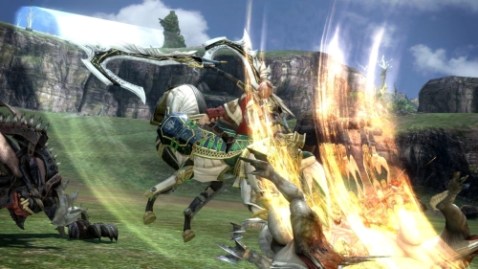
Yes, it takes a while, but you do get there eventually, and that’s part of the point.
From one perspective, there’s only one challenge in any given game, and that’s the last sequence. Every other portion is just there as training.
Obviously, the goal from a design standpoint is to have all of those intermediary challenges be just as fun. But they’re also there to train you for the final things, the real events, the big time. It’s the reason why games don’t start with the final boss fight, because you need to learn all of the elements that go into that fight. The first level in Super Mario Bros. introduces most of the major elements you’ll deal with through the game, and it does so in an environment wherein you can fairly easily learn how they work.
Every game is different, however, and there are lots of ways to teach players how to do things. So how do you teach players how to do the things they’ll have to do at the end of the game while still making the beginning of the game fun to play?
 Recent Work
- An error has occurred; the feed is probably down. Try again later.
Chocobo Dash
- An error has occurred; the feed is probably down. Try again later.
 Eliot Lefebvre