The Final Fantasy Project: Final Fantasy IV: The After Years, part 2

Artwork from a sketch by Yoshitaka Amano
As much as it surprises me to say so – and it does surprise me quite a bit, let me tell you – I’ve been enjoying The After Years up to this point. Sure, Ceodore’s only got the thinnest sketch of character motivation, but he’s not exactly alone in this fact, and the general feel is of events cascading quickly out of control while at the same time not feeling forced. He’s lost a lot, possibly everything, but he still has the will to push through.
Of course, will doesn’t make monsters not attack you, and not too long after his dying order from his commander, he’s being accosted by beasts. The first two are barely even relevant, but the third one has him on the ropes until someone mysteriously jumps into battle. Someone with narrow features and a portrait that makes strong eye contact. Someone with long blonde hair and a penchant for appearing dramatically. Someone who is referred to as only “the Hooded Man,” despite the fact that his identity is immediately obvious to anyone familiar with the original game.
Do we have to pretend we don’t know him? We… we do, don’t we.
Hard Project: Sonic the Hedgehog

When a series resorts to mining out its past, it’s usually because the present is much less interesting.
This may come as a shock to some of our younger readers, and for that I apologize. But you know all of that terrible art on DeviantArt that involves cartoon hedgehogs submitting to Jesus and usually leads directly into some mind-scarring pornography? That’s all based on a series of video games! A series of video games that were originally based around a little blue hedgehog that ran really quickly. You have to understand that the 90s were a different time. (We don’t understand how the porn and the Jesus thing happened, though.)
As funny as that might seem at a glance, the fact of the matter remains that the weird fan culture has become the most relevant part of the Sonic the Hedgehog franchise in recent years. Kind of understandably so, even. The franchise has been showing cracks ever since the Dreamcast days, and the current state of affairs is lamentable but hardly unexpected. At this point, making a new game is quite possibly not a good idea, and it’s definitely a hard project.
Demo Driver 8: Satazius

Considerate enemy armadas build ships that are designed to be dangerous from exactly one angle and utterly non-threatening in every other configuration.
It’s weird to see a game that’s specifically targeting your own nostalgia when, by and large, you steer clear of gaming nostalgia. I’ve been playing video games for a long portion of my life, and I know that I’m not immune to the siren song of old loves, but I like to think I’m also aware of the fact that the past of video games is filled with missteps, bad decisions, and stuff that made sense at the time but not now. My affection for the past is rarely within sight to be targeted at all.
And then, of course, I find a game that is a direct throwback to one of my longstanding loves, a shoot-’em-up in the mold of Gradius, Darius, and R-Type. While the master genre never died, I’ve noted in the past that it’s tapered off into a steady stream of bullet hell shooters, which I have less affection for. Satazius, by contrast, feels very much like a familiar variant on old tropes, so much so that I had to double-check that it isn’t a remake of something. They found my one weakness.
Telling Stories: You need to make the money
 Let’s be real here – no matter when your game is set, professional murder is not a particularly good way to make a living. Sure, the definition of “professional murderer” is a bit more limited than the usual catch-all of “adventurer,” but the number of characters I’ve seen in games that are actually purely adventurers is pretty small. However you’re making your money in a mechanical sense, your character is probably finding a way to make money that doesn’t involve roaming around outdoors and swording small woodland creatures for cash.
This is usually glossed over, mostly because no one wants to come home after work just to pretend to do more pointless work. (Pointed work is a different story.) But you can get a lot of mileage out of having a character with a job that isn’t either an offscreen concern or a de facto license to traipse about and kill woodland critters after all. So let’s talk about that.
Challenge Accepted: Teaching patterns
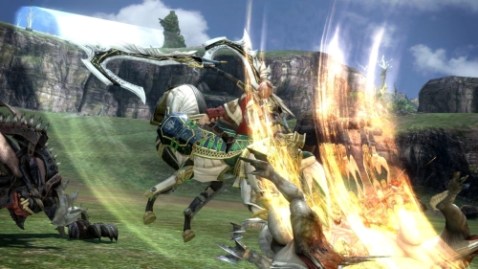
Yes, it takes a while, but you do get there eventually, and that’s part of the point.
From one perspective, there’s only one challenge in any given game, and that’s the last sequence. Every other portion is just there as training.
Obviously, the goal from a design standpoint is to have all of those intermediary challenges be just as fun. But they’re also there to train you for the final things, the real events, the big time. It’s the reason why games don’t start with the final boss fight, because you need to learn all of the elements that go into that fight. The first level in Super Mario Bros. introduces most of the major elements you’ll deal with through the game, and it does so in an environment wherein you can fairly easily learn how they work.
Every game is different, however, and there are lots of ways to teach players how to do things. So how do you teach players how to do the things they’ll have to do at the end of the game while still making the beginning of the game fun to play?
 Recent Work
- An error has occurred; the feed is probably down. Try again later.
Chocobo Dash
- An error has occurred; the feed is probably down. Try again later.
 Eliot Lefebvre