Demo Driver 8: Imperium Romanum Gold Edition (#374)

Our artist’s recreation of the city before the incident under discussion. He works, like, really fast.
Before I explain what happened in Genoa, senator, I feel it’s only fair that I set the appropriate context.
When you sat me down in Genoa, I didn’t have a forum, I had a shack with a central road. There were no roads linking the forum to the fishing regions that the Senate considered so vital to restoring the town. There were no houses. You had even neglected to inform me that a warehouse had been constructed on the other side of the nearby mountain line, thereby necessitating an expensive (and troublesome) expansion to the east just so I could establish a supply of timber and stone. When I found out later that there was another deposit, I of course was overjoyed.
But the demands of the Senate in this situation were unreasonable. You have asked me to build more fine stone architecture, more homes made of stone, a monument commemorating the city’s restoration. Do you know how much stone that takes? Do you know how much stone there is around Genoa? Because I do. The answers are, in order, “a whole lot” and “not much.” Not nearly enough for the temples and the fine stone homes and the monument and the other temple.
Once you understand that, it’s a lot easier to understand how the fire got started.
Telling Stories: You’re not that girl
 Roleplaying is, in part, the act of getting into your character. You kind of have to. Like an actor stepping into a role, you become this character, start understanding how they work and what they want, try to produce a coherent picture of what they’re all about. You want to get to a point where the character’s actions are as natural to you as your own, when you rarely have to think about what your character would do in a given situation because it’s almost entirely self-evident. Which makes it just a little strange when you have to also step back and remember that this character is not any part of you.
Perhaps that’s stretching it – you always invest a bit of yourself in your characters, obviously – but you are still separate. You aren’t the same person. What happens to the player is not dependent upon what happens to the character, and even just speaking from experience there are a lot of things my characters do that I’d never even consider. So let’s talk a little bit about creating that space and pushing back against identifying too much.
Expanding beyond Titanfall’s server limitations
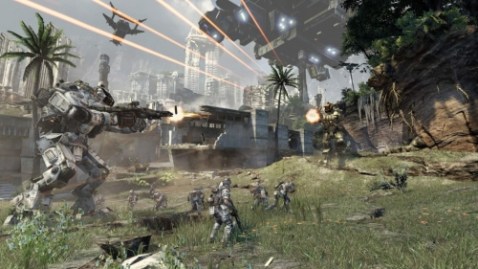
A game about giant robots can now be played almost entirely with robots.
Last week, Titanfall set up what I think is a very fair penalty system. If you are caught cheating, you are not banned, you’re simply banished to a server where everyone else is also a damn cheater. So you will be more than able to enjoy the game, if what genuinely makes the game fun for you is playing amidst a field of cheating bastards.
Incidentally, that was the original title for Sting’s “Fields of Gold,” I believe.
I feel this is an excellent first step, but by no means the final one. This is a brilliant concept that is almost infinitely expandable, allowing companies to ensure that players get to live with the people what will nurture and understand them. Or at least understand them. All right, that’s not really what I’m concerned about so much. There are toxic and vile people on the internet who seem to enjoy spreading vile toxicity into the games that we love, and perhaps we could use this same methodology to deal with people best surrounded by one another in the hopes that they may realize “wow, I am extremely annoying.”
The Final Fantasy Project: Final Fantasy I, part 4

Artwork from a sketch by Yoshitaka Amano
As I’ve mentioned several times now, Final Fantasy is not a lengthy game if you know what you’re doing. It’s not even all that lengthy if you don’t, honestly. All of the stuff I’ve written about in the last three entries took me about ten hours to complete, and if you’ve been playing the game as long as I have it’s likely you can do the same. Square had pretty much acknowledged the brevity of the game by releasing it almost exclusively as a package deal with Final Fantasy II for years, but when it came time to recreate the game again for the Game Boy Advance someone had a brainstorm.
That brainstorm is the Soul of Chaos. Four dungeons, each thematically linked to one of the four Fiends and sporting bosses from a later game. The Anniversary release also adds in new music for these bosses, remixed versions of their battle themes from the respective games. So if you want to accept the newest version of the game as canon, it means that these bosses appearing later is a reference back to the first game, even though they’re appearing in the first game as references to the later games.
Like I said, it’s sort of weird. But sort of awesome, too.
Hard Projects: Star Trek
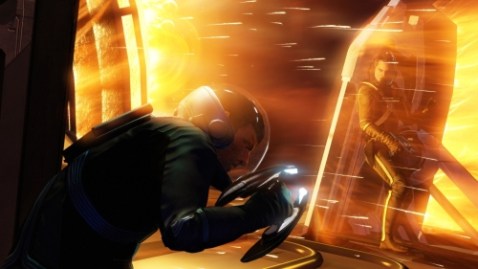
It’s the reviews, sir, and they’re not happy!
There’s no way I could convince anyone reading this that I don’t love Star Trek Online. I wrote a whole piece about it. And it’s all true, Your Honor, I think it’s a great game that comes as close as any game has to capturing the spirit of the series. In fact, it might even seem unfair to list Star Trek here at all, seeing as we’ve been nearly buried under a variety of Star Trek games with varying critical reception. Some are seen as particularly good, some are seen as middling, but very few houses get the license and turn out something execrable.
Yet it’s always a tricky prospect. Star Trek Online languished in development hell for an extended period of time, killing the first studio working on it. Many of the games languish in that impermanent hell toward the bottom of the “acceptable” scale when they hit review time, many of them sliding below that. And nearly every single one faces criticism about its use of the license, with people hand-wringing and asking whether or not the game really fits in with the ethos of Star Trek as a whole.
So what makes this so hard to adapt?
 Recent Work
- An error has occurred; the feed is probably down. Try again later.
Chocobo Dash
- An error has occurred; the feed is probably down. Try again later.
 Eliot Lefebvre