Hard Project: Half-Life
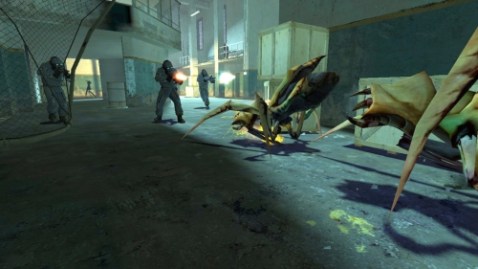
Defiant!
Half-Life is not one of the most voluminous franchises in existence. It consists of the original game, a smattering of expansions for that game, the sequel, and two-thirds of an episodic follow-up to that sequel. Oh, and a whole lot of talk, which puts me in the mind of paying money for an idea, but so long as there’s no Kickstarter my carefully cultivated rage gene doesn’t get activated by pretentious talk by people who cannot get a video game to launch.
Then again, I may be a little harder on Gaben & co. than they deserve. I’ll snark endlessly at the fact that it has taken seven years without so much as a peep about Half-Life 3, but when you think about it, it’s a hard project to start on. Not because of lack of money or licensing rights, but because the game has some pretty huge shoes to fill, and a whole lot of baggage that’s weight the hypothetical down.
Demo Driver 8: Magic 2014
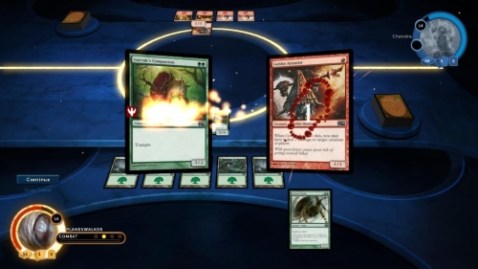
This is as dramatic as it gets.
Usually, I play a demo all the way through to the end before I make a comment on it. But not this one. I passed the half-hour mark and I was already done, largely because I didn’t need a great deal of introduction to playing a card game that I had already played for several years and have opted out of continuing to play for a variety of reasons.
The easy verdict here is that this is the most recent version of the game, and if you’re looking for a version of Magic: the Gathering that works as close to a box set of the game could possibly work, here is your game. Based on the demo, it provides exactly what it advertises on the tin, which is a faithful digital recreation of the card game as it stood when the game was made, frozen in time and yet with a clean visual interface and implementation of the rules. It manages to hit enough of the genuine game’s notes without being the same game, which is noteworthy. At the same time, it’s also a bit buggy, and it doesn’t exactly do the source material any favors.
You’re probably looking for a bit more, huh?
DmC and the crossroad

Simultaneously a terrible, bland, generic protagonist and a protagonist of surprising depth and clarity.
DmC: Devil May Cry is a game trying to be two things at once. If I thought it was intentional, it’d be brilliant.
It’s a game that wants to criticize the young male power fantasy and the utter silly emptiness of it while at the same time reveling in the trappings. It wants to be an action film, it wants to be a drama of a war between demonic forces. It wants to create a strong and self-sufficient female lead while at the same time making her a damsel in distress for the protagonist to rescue. It wants maturity and then revels in exploitation, it wants depth and shallowness at once, it wants to be taken seriously and yet has a solid minute of characters yelling obscenities at one another louder and louder.
To say that it’s kind of all over the place even without touching upon the gameplay elements would be understating the matter. And if there’s a game that more perfectly encapsulates the state of gaming and gamer culture at the moment, I certainly can’t think of it.
Challenge Accepted: When good trouble goes bad
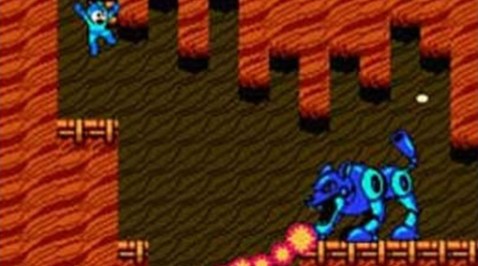
The first time you see these, you understand their attack patterns. The other way around, it would kind of be for crap.
If you’ve played Megaman 2, you know about the disappearing block segments. It starts as a simple jumping puzzle and gets more dangerous as time goes by – blocks fade in, then fade out after a second or two, forcing the player to jump from one vanishing block to the next, a masterpiece of careful timing and understanding the patterns. But the game didn’t stop there. Several of your “weapons” allowed you to make platforms which moved in unique ways. The result was that even though the segment was tricky, if you had too much trouble with it, you could bypass it. You’d have less energy on those tools if you needed them again and had to choose the right tools carefully, but there were other options.
By contrast, when the blocks reappeared in a couple of the more recent games in the Megaman X series, you didn’t have access to those extra abilities. As a result, the challenge became much harder and – really – a lot less fun. You either did it perfectly or you had no alternative. In Megaman 4, meanwhile, the platforming elements in many stages were so easy to bypass you could basically ignore them altogether. They took a good core challenge and wound up making it not nearly as much fun any longer.
The Final Fantasy Project: Final Fantasy IV, part 5

Artwork from a sketch by Yoshitaka Amano
Things are cascading toward what would appear to be the endgame awfully fast in Final Fantasy IV, although the chances of it actually being the endgame are about nil. For one thing, I’d be really surprised if one of these games ended with characters in the late teens or early twenties in terms of level. Also I’ve still got more elemental fiends to face, I’m sure, and there are a lot of plot elements still unexplained. Plus, you know, I checked.
But we’re still swinging right along in our goal to get an airship, rescue Rosa, kill Golbez, and then… do something? I don’t know if Cecil actually has a plan for the endgame here. Once Yang is kitted out again with some equipment retrieved from the Fat Chocobo and a few more things bought in Baron (you can unlock those stores now), it’s time to move forward! By which I mean it’s time to totally ignore stated objectives and head back toward Mist, because there’s stuff there, even though it makes no sense whatsoever.
 Recent Work
- An error has occurred; the feed is probably down. Try again later.
Chocobo Dash
- An error has occurred; the feed is probably down. Try again later.
 Eliot Lefebvre