Demo Driver 8: The Night of the Rabbit (#181)

You said it was night, but this looks pretty much like day to me.
I’ve never felt wholly comfortable mocking point-and-click adventure games. I’m fine sharing my thoughts on the genre as a whole, but the thing is that most of them come across as almost unbearably earnest. They sustain themselves almost wholly on presentation by writing and art. Critiquing the gameplay is an easy shot, and while it’s a worthwhile topic of discussion, it doesn’t change the fact that the game in question is essentially coming to you hat in hand while asking you to be a mildly interactive participant in what comes down to a storytelling session.
At the same time, this is a genre that has some pretty significant problems as a result, so I don’t feel that it’s fair to just leave off mentions of the nature of point-and-click adventure games. They’re not quite as much a non-game experience as the dreaded “Walk Around and Stare” genre, but you’re still stuck clicking about and hoping to have an impact. So you can imagine that I’ve got some conflicted feelings about The Night of the Rabbit right out of the gate.
Should Bravely Default be a Final Fantasy game?

In most fantasy RPGs, having amnesia is like one better than having an iPod.
When is a duck not a duck? When is a Final Fantasy title not a Final Fantasy title? What does the former even mean these days?
There used to be a really clear distinction. Games were called Final Fantasy when they were part of a huge long series of games, each of which consisted of the same two words followed by a number. You can argue the point a little, sure – Mystic Quest exists, the first Seiken Densetsu game was marketed as a Final Fantasy gaiden – but by and large this was the abnormality. But now we’re deep into sequels and prequels and spinoffs that are, just the same, branded as part of Final Fantasy. The reason Final Fantasy Dimensions is called that instead of, well, Final Fantasy (previous installment +1) is pretty much arbitrary.
But it gets really weird with Bravely Default. Here’s a game that’s developed by a studio that has worked on Final Fantasy before. It’s a spiritual sequel to Final Fantasy: The 4 Heroes of Light, which itself is a spiritual sequel to Final Fantasy III‘s remake, which could almost be considered a sequel of sorts to Final Fantasy III due to the extensive nature of the remake. It obviously adheres pretty damn closely to the standard Final Fantasy tropes. I’ve seen people go so far as to say that in a just world, it would be a Final Fantasy title.
Should it be? That takes some talking. Read More…
The Final Fantasy Project: Final Fantasy I, part 2
Artwork from a sketch by Yoshitaka Amano
Remakes of the first Final Fantasy have an odd dichotomy going. In the early parts, it’s easier to be curmudgeonly about the more “faithful” remakes while wishing for a game that isn’t brutally crushing you at every turn solely by fiat. As the game goes on, though, the more modernized versions start inspiring more ranting about how things were back in your day.
But that’s a little further along in today’s entry. As you probably remember, we left things off right around the time when the game finally remembers what the stated goal was at the beginning of the game. You know, when you’ve finally finished derping around enough that you could go deal with the Earth Fiend. Which is annoying, but in a way I almost wish the game had continued along that vein, sending you on elaborate, sprawling sidequests just to make a little forward motion. It really creates the sense of two distinct games, where you spend a whole lot of time getting to fight the Fiends at all and then you just sort of kill them in quick succession.
There are only a few places where you can break from the game’s very linear sequence, and taking care of the Earth Fiend first is not one of those places. It’s more obnoxious than all that, really – you have to descend, kill a vampire, open a passage, talk to an NPC who literally does nothing else, then go back down and actually kill Lich. It’s kind of pointless, and it feels like padding the length of the game without even giving you an extra dungeon to go through by forcing you throw the same dungeon twice.
Demo Driver 8: Jagged Alliance – Back in Action (#65)
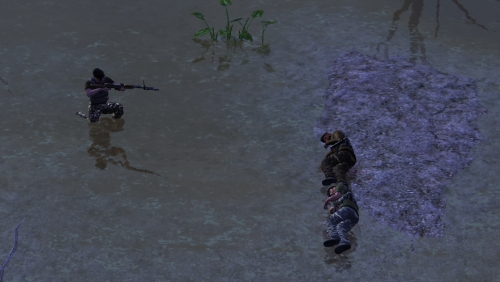
Dead in the water.
The best sort of demos make you intrigued about what the game has to offer. The worst get you bored with the concept.
Last week’s candidate was a demo for something that I wouldn’t call good, but it also wasn’t something I’d call bad. I felt like after taking my time, the demo left me with a good sense of what the game would play like, but also left enough blanks in the picture that I didn’t feel I could entirely satisfy any cravings simply through the demo. It was solid, it teased, it made its central hook known.
Jagged Alliance – Back in Action does not have a particularly good demo. In fact, what it has is a stilted tutorial and a single mission that both manage to remind me of why I long considered PC gaming to be far more tedious than it needs to be. And from research, it’s not really the fault of the franchise, but a combination of a developer doing a poor job of adapting a game and the demo doing an even poorer job of making the game seem enjoyable.
The Final Fantasy Project: Final Fantasy I, part 1

Artwork from a sketch by Yoshitaka Amano
The Final Fantasy Project is a look back over the franchise’s entire history, starting from the beginning and moving up to the most recent game when I finally finish this whole thing. Those of you who have followed my work in various places may remember that I already started this project over the summer, but it sort of fell off the radar between a combination of Final Fantasy XIV and the steady realization that the format I had picked was not actually a good one for what I wanted to do.
So consider this a revival. Not a reboot, though; I’m still pretty happy with what came out of my work over the summer, so the first couple of weeks are going to involve a repost and cleanup of what was written during the initial run. That’ll be compressed as much as possible, but if you really want to spoil yourself, the original versions are out there. So let’s start from the very beginning.
 Recent Work
- An error has occurred; the feed is probably down. Try again later.
Chocobo Dash
- An error has occurred; the feed is probably down. Try again later.
 Eliot Lefebvre