Demo Driver 8: Magic 2014
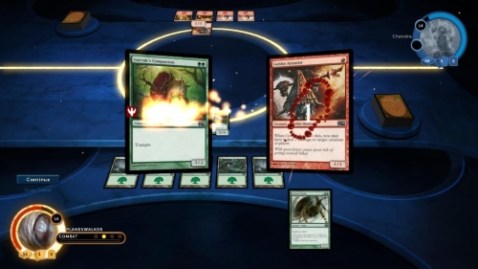
This is as dramatic as it gets.
Usually, I play a demo all the way through to the end before I make a comment on it. But not this one. I passed the half-hour mark and I was already done, largely because I didn’t need a great deal of introduction to playing a card game that I had already played for several years and have opted out of continuing to play for a variety of reasons.
The easy verdict here is that this is the most recent version of the game, and if you’re looking for a version of Magic: the Gathering that works as close to a box set of the game could possibly work, here is your game. Based on the demo, it provides exactly what it advertises on the tin, which is a faithful digital recreation of the card game as it stood when the game was made, frozen in time and yet with a clean visual interface and implementation of the rules. It manages to hit enough of the genuine game’s notes without being the same game, which is noteworthy. At the same time, it’s also a bit buggy, and it doesn’t exactly do the source material any favors.
You’re probably looking for a bit more, huh?
Telling Stories: Get wasted
 Show me a game setting without drugs of some kind, and I will show you a setting that is either intended for young children or one that has not been adequately developed.
Pretty much every setting has alcohol, and The Secret World by definition has all of the usual real-world chemical cocktails. Final Fantasy XIV has somnus, milkroot, and presumably moko grass (it does turn into hemp, after all). WildStar features beer and cigars as more or less background elements. World of Warcraft has bloodthistle, and blood elves in general. City of Heroes had superadine on top of real-world drugs. That’s just scratching the surface.
Odd though it might seem, drugs are pretty important in roleplaying, even if you’re not playing a character who actively has a problem. The cultural impact and overall implications have a major impact on your character no matter what, and you can use them to add a fair bit of nuance to your portrayals. So with the understanding that you as a player should probably not be taking illegal drugs, let’s talk a bit about using drugs in RP.
Telling Stories: Avoiding cabinet flaws
Once you get the idea in your head that characters should be flawed, you don’t immediately know how to go about making that a thing. So you wind up with characters who have cabinet flaws, and over time you solve those flaws, and then suddenly your character isn’t flawed any longer. You’re right back to boring old square one, but you can’t not address the cabinet flaw, right? The whole reason it’s there just cries out to be addressed and rectified!
Of course, it would probably help if I took a step back and defined what I meant in the first place by a cabinet flaw.
See, the idea of character flaws is easy to comprehend. You want your characters to have problems, to have to struggle to overcome something. At their core, flaws are problems. So you give your character an obvious hole in their abilities, something that they distinctly cannot do rather than will not do. The archetypical example is a paladin who’s ruggedly handsome, brilliant, and fearsome on the battlefield – but per the name, he can’t fix cabinets.
Telling Stories: Fueling the maze-builders
Two weeks ago, I put forth what I think is a fairly simple philosophy for getting storylines moving in games – I don’t build the story. I just lay out tools, and the other people involved happily build the maze themselves with a minimum of prompting from me. I’m proud of the article and think it’s pretty completely on-point. What I didn’t go into depth about was how you do that.
Sure, it’s all well and good to say you assemble tools, but I’m willing to bed that if you put some lumber and some tools in the yard and then hide, you will not find people coming by just to build you a shed.
A lot of it comes down to tricks that work during tabletop roleplaying and are easily ported to roleplaying arcs just as easily, with a few added tricks brought on by the nature of the beast. So once you’ve got a plan in mind, it’s time to start putting your tools in place and using them to let players assemble a maze you never even had to sculpt.
Telling Stories: Safe and sound
I would really like to tell a story wherein the roleplaying community is notably different from the raiding community or the PvP community or any other community and isn’t filled with all sorts of creepy players who will make you want to stop playing altogether. The only thing preventing me from telling that story is the fact that it’s not true.
Let’s face it, roleplaying isn’t exactly like any other community, but it still has those hallmarks. There are creeper and weirdos who will make you awkward, people who have no sense of personal boundaries, and a varied assortment that will make you feel some combination of unwelcome and frightened until you just leave. It’s not unique to online games, either. For some people, roleplaying just seems to lead straight into creep-ville territory. It’s gross and unpleasant, but it’s true.
I am going to assume that no one reading this wants to be a big creepy jerk who drives people away from their game of choice, although whether or not you achieve that goal anyway is another discussion. Today, I want to talk about keeping yourself safe and comfortable, though, and it’s a good idea to make sure that you don’t violate anything contained herein if you’d like to avoid being super-creepy. Yes? Yes.
 Recent Work
- An error has occurred; the feed is probably down. Try again later.
Chocobo Dash
- An error has occurred; the feed is probably down. Try again later.
 Eliot Lefebvre