The Final Fantasy Project: Final Fantasy V, part 3
Artwork from a sketch by Yoshitaka Amano
So Lenna is convinced that her father’s wind drake is on top of the nearby mountain, and the rest of the party agrees to go along with this because, well, they weren’t doing anything. Also there’s no other route to the water crystal than via the air at this point, so that’s a good motivator. The trek to North Mountain isn’t terribly interesting, with its very name making it pretty clear where you’re heading.
As with most dungeons that take place on mountains through the series, this is not a particularly interesting or ornate area, largely linear and without much in the way of hidden passages. What is interesting is that you’re probably moving along nicely with your character jobs by this point, unlocking some abilities to toss into your secondary slot and probably considering swapping jobs on some characters. This is actually reasonable, since later job levels take more and more ABP to learn, but later enemies reward more ABP for clearing a battle. If you haven’t been constantly swapping, as you move through this dungeon you’ll start picking up some real options.
Telling Stories: Why aren’t people getting into this?
 The worst possible thing to feel when you’re lining up roleplaying is to have a big pitch all ready to go, plenty of planning on deck, and when the big day arrives… nobody cares.
It’s true online or in tabletop form. I’ve run tabletop campaigns wherein I had really cool ideas for a plot and characters custom-made by players to fit within those fields, but when push came to shove it turned out that no one was actually on board with the unfolding story. I’ve organized what seemed like really spiffy events to me that turned out just one or two people (which, in this case, was less than I wanted). I’ve been ready to go and gotten sort of left to one side.
So why aren’t people engaging? Why can you have an event or a story ready and then find no one willing to actually engage with what you’re doing? There are lots of reasons, some of which are more common than others, but there are a few questions that can help you at least fix the problem in the future, even if you can’t salvage what’s already gone south.
The Final Fantasy Project: Final Fantasy V, part 2
Artwork from a sketch by Yoshitaka Amano
Once you have access to the jobs, the complexity of Final Fantasy V kind of explodes. Not in a bad way, you’re not being smothered by stuff to do, but the overall change is pretty notable. You have a new swath of jobs to use, and suddenly you have to deal with an aspect of gameplay that has not been an issue in any previous installment of the franchise to date.
Previous installments of the franchise didn’t feature a lot of choice, or at least not much in the same sense of playing around with jobs. Even Final Fantasy III barely cared which job you had been leveling with before; it was all about what you were doing now, after all. Level as something that turned out to be useless and then change? You don’t miss out on much. But here, useless and useful jobs have an impact. Leveling now has an impact on what you’re doing while leveling later. Planning well means negating later grind.
Hard Project: The Matrix

How could this have gone wrong? Oh, wait, all the ways.
The Matrix is one of those things that was a very big deal when it came out and then faded in importance about five minutes later. It’s been a decade since the last film, and the odds of us seeing another one are slim to none. Which is a shame, because it’s still a franchise I like quite a bit, even if I’d like it more if we had gotten the prequel-and-sequel the Wachowskis had originally wanted instead of the single sequel split into two parts.
If you like pretending the two sequels didn’t happen, imagine them as one lean two-hour film and start falling in love again.
We’ve seen three games based on the franchise, with one of them (The Matrix Online) both failing to live up to the promise of that concept and completely failing to deliver on what was originally conceived of in a persistent universe. It kind of makes sense, if you think about it. Even though the movies look great and prompt lots of thoughts vis-a-vis “man, it’d be great to play this as a game,” the whole thing winds up being a really hard project from the word go.
Demo Driver 8: Wings of Vi
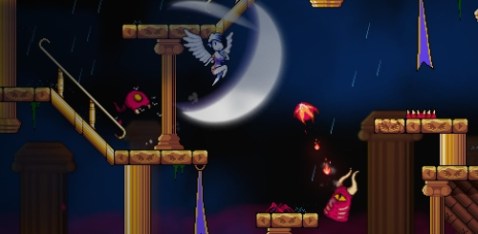
She looks so mildly out-of-sorts all the while.
I’m not sure if satisfaction or frustration dominated my playtime with Wings of Vi. I’m not sure if I would want to play it again or not. But I will say that the question isn’t as open-and-shut as I would have guessed from its description, so it gets points for that.
Much like last week’s entry, Wings of Vi is aiming at being a retro-style platformer, right down to evoking the feeling of brutality that you would get from 16-bit games at times. As soon as I read that, images of platform hell and the sheer constant roadshow of everything everywhere trying to kill you danced into my head. Add to that a buxom and rather lackadaisically dressed protagonist, and I was not hopeful.
Fortunately for my continued sanity, the game is most definitely not an entry into platform hell, despite the fact that its narrative concerns warring against a very literal hell. Which alone gives me hope, because while the game aims at being hard – and one could argue about “too hard” here and there – it does so in a much more imaginative manner.
 Recent Work
- An error has occurred; the feed is probably down. Try again later.
Chocobo Dash
- An error has occurred; the feed is probably down. Try again later.
 Eliot Lefebvre