The Final Fantasy Project: Final Fantasy’s first generation

Artwork from a sketch by Yoshitaka Amano
You know what I really wish the end of Final Fantasy III signified? That I could move off of my PSP. Sure, I love the system, but I’d really like to be playing these games in a format that allows for proper screenshots. Alas, the rules I’ve laid out keep me on this handheld through Final Fantasy IV and points related, not that things get much better once I move on to Final Fantasy V.
What it actually symbolizes, however, is that I’ve finished up the last game in the franchise that appeared on the NES, or the Famicom if you’d prefer. All three editions are remakes, yes, but the original games started life in the 8-bit era. It’s an interesting element that’s easy to overlook in favor of strict linear progression, but I think it has important implications and information about the franchise as a whole. Yes, in some ways the hardware was just that – hardware, the stuff powerful enough to run these games. But it also has implications for breaking up the flow of the series and how it’s evolved over time.
Hard Project: DOOM
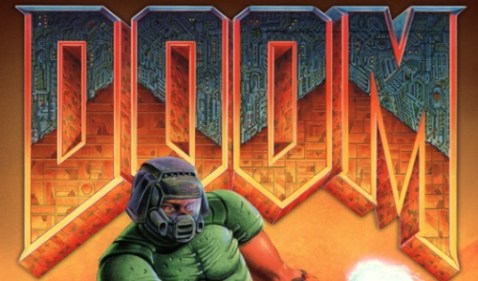
It’s so hardcore it doesn’t even need a description beyond one word.
Calling the original DOOM anything short of a game-changer would be underselling its importance. It was a polished, unique experience, more or less creating the first-person shooter experience in the eyes of many players. It was a shareware title, which made it easy to learn about. It was violent for its time, another feather in the cap of a game that was already laser-guided to reach the hearts of a very definite audience. It was beautiful. It was stunning. It let you blow demons up with a shotgun or carve them up with a chainsaw.
Best of all? It was modifiable by users with minimal effort. Which was pretty important.
In the early days of the Internet, DOOM and its functionally almost-identical sequel, Doom II, were a big deal. Doom 3 – the first actual sequel the game had in a decade – met with positive reviews and it was a success, but it sure as heck wasn’t a success like its predecessors. Heck, it didn’t even match those games in tone, being far more concerned with the idea of sneaking through darkened regions and navigating linear stages. But that’s kind of to be expected. Making Doom 3 was always going to be a difficult proposition, and there’s a reason why the next installment is languishing in development hell. This is a hard project.
Demo Driver 8: Tank Universal (#265)

At least it’s not World of Tanks.
I’m never going to quite understand the ways in which people love – absolutely love – first-person tank games. This is not a new genre by any stretch of the imagination, as I remember playing a tank sim back on my ancient 486 PC in the days when the Turbo button meant something and a VGA monitor was absolutely pimp. I also remember frequently being kicked out of that game because I “accidentally” hit my own side with mortar fire, which may or may not have actually been an accident.
Tank Universal is meant to speak to that urge while also indulging in your urge to pilot a digital tank in Tron. The game doesn’t even pretend otherwise. This is blowing things up in an arcade-ish setting that is only “inspired by” Tron in the sense that it can’t legally be set in the movie universe. And while it suffers from a weak UI and some overall transparency issues, it largely does exactly what it sets out to do with a fair amount of competence and grace.
Telling Stories: Three big memories (and why they stand out)
 Over the years, I’ve done a lot of roleplaying. So much so that honestly, I don’t remember most of it.
I don’t mean this in the sense that I’m not paying attention, just that roleplaying enough means that things are slowly going to fade into memory. You can’t be expected to hold onto a decade of memories with perfect clarity if you’d like to remember trivia like the names of your cats and whether or not you paid the phone bill.
But some stuff sticks out, memories that you couldn’t get rid of even if you tried. So here are a few of my best, as well as some thoughts about why I still remember these and what lessons you can learn from them, good and bad. Because there’s a reason why a lot of roleplaying fades into the background as “important but not memorable” while other pieces stick out for years afterward.
Challenge Accepted: Competitive vs. mechanical balance

We like to think it’s like this, but it’s really more this with a smaller set of scales beneath each hook, and another set there.
When we talk about balance, we’re really talking about two different things, because not all balance is identical.
In one sense, games like Street Fighter II are pretty balanced. A good balancing patch requires going through the game as a whole, evaluating what characters can do, and making sure that moves operate correctly and don’t create too few or too many answers to another. In another sense, games like Mass Effect 3 are pretty balanced, wherein every tactical choice you can make with your character is about as strong as every other choice you can make with your character. But the two don’t line up quite right.
There’s no PvP in Mass Effect 3, but it doesn’t take a lot of work to see how certain classes in multiplayer would be helpless without other classes – yet the whole thing is fairly balanced. Because it’s not balanced the same way as a game like Street Fighter II. That’s what I want to examine and talk about today, the way that the two sorts of balance don’t always play well off of one another and how the style of balance makes a big deal for the game.
 Recent Work
- An error has occurred; the feed is probably down. Try again later.
Chocobo Dash
- An error has occurred; the feed is probably down. Try again later.
 Eliot Lefebvre