The Final Fantasy Project: Final Fantasy III, part 11
Artwork from a sketch by Yoshitaka Amano
Fun story about the endgame area here: while the game was still in design, it was discussed whether the last area should feature a save point or not. It was decided against because it would make the game “too easy.” So instead, you have to fight six bosses and climb through a huge long dungeon with no chance of saving, and if you die for any reason you have to do the whole thing all over. Thanks, guys. That was a great decision and I’m super glad you made it.
Those irritations I’ve had about the remake come full circle here; these bosses posed enough of a challenge in the original, but giving them all extra attacks results in the degenerate state wherein one of them can literally kill you in one turn if you get unlucky. Seriously, you could at least have added a “continue” option for groups that get unlucky. Throw us a bone here. I suppose it is the source of darkness, though, you can expect certain amounts of unfairness.
Undeveloped extensions

Look what we found just lying around!
A couple of weeks ago, I talked about minigames that we never need to see again in another game, full stop. It was meant to be silly, and I think it accomplished that goal nicely. But, you know, it also does speak to the fact that we have some ideas that have just been mined out straight through to the mantle. There is no more blood coming out of these stones.
No, I’m not about to go on a rant about how companies are only producing the same games these days, since that’s both demonstrably wrong and kind of the nature of the beast. The majority of titles at a given time are always going to be the most popular current thing with a new skin; that’s always been true. But there are a lot of ideas out there that saw exploration in one or two titles, then got shelved forever. In short, there are clever new ideas there just waiting for a dust-off and a revival with newer tech and a modern environment, ideas that are just longing to be developed. So let’s talk about titles that can’t be hard projects because they’re barely even franchises, but they still deserve some more attention.
Demo Driver 8: The Stanley Parable Demonstration

Please do not read the alt text for this image.
It’s hard to talk about The Stanley Parable without sounding like you’re a pretentious twit who uses the word “metatextual” far more often than is healthy. (The FDA recommends using it no more than twice per 1000 words.) And The Stanley Parable Demonstration is even a layer beyond that. It’s not so much a demo as it is a metatextual examination of game demos, layered on top of a game that is itself an examination of choice and the illusion of agency of games. So it’s at once trying to convince you to buy a game based on nothing from the actual game, and it’s also trying to point out the futility of trying to demonstrate a game in that fashion.
While it may come as something of a surprise based on all of that, it’s actually fairly effective at giving you an idea of what you’re going to be getting into. It presents its questions, gets you to ask some questions of your own, and the whole thing plays out with just the right mixture of not actually being a game adjacent with just enough player agency. Even if it’s mostly an illusion.
Telling Stories: Playception

I do not know why it is that people like the idea of putting on a play in-character. Seriously, couldn’t tell you. It’s kind of ridiculous, you’re already in the midst of a play in the first place. You’re doing the same thing, only another layer down. I suspect that eventually you’d wind up with players roleplaying their characters who are also roleplaying characters who themselves start roleplaying, going four or five levels deep before you start asking what the heck is going on and what series of life choices brought you to this point.
However, I also know that I love the idea, because I totally want to see my characters on stage and hamming it up. Nonsensical? Sure. Also fun as hell.
Of course, if you didn’t already know (and you probably did), putting on an actual play is an activity fraught with pitfalls and problems. Putting on an in-character play is even more problematic. So let’s take a look at what you can use to make it go… well, not smoothly, it’s not going to go smoothly, but at least less poorly.
Electronic Arts: Not the devil you want
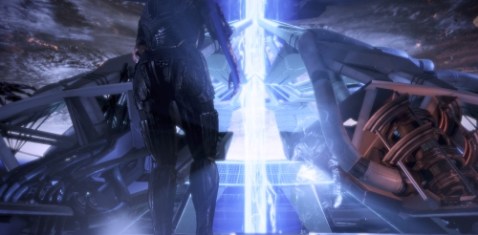
If you’re blaming EA for the fact that you disliked the ending of Mass Effect 3, you should probably take that back down a notch.
I’m just going to go ahead and leave this right here: if you’ve spent a good chunk of your time online screaming about how EA is the worst company in the world, you are why companies think gamers are idiots. Yes, you.
EA, as a whole, is a company you basically can’t have a normal conversation about. It’s one of the biggest publishers in gaming – there’s a reason the company gets its own stage time at E3 when that’s eaten up mostly by the companies producing actual consoles. And the company has a huge stable of studios it owns, game it publishes, and things it sells. Oh, how it will sell things. It was one of the first companies to open up microtransactions in-game, and the company’s history is a long one of doing things that make money, first and foremost.
None of that should be surprising. It’s a company, it’s devoted to making money. But when you talk to gamers online, there’s this image that EA is the literal actual villain of the game industry. Which at best makes gamers look like a batch of petulant, entitled twits, and at worst makes us look like we don’t collectively know what we’re talking about. Usually both at the same time, really.
 Recent Work
- An error has occurred; the feed is probably down. Try again later.
Chocobo Dash
- An error has occurred; the feed is probably down. Try again later.
 Eliot Lefebvre