Telling Stories: With my weapon

Let’s kick this column off with a rhetorical question. Why did Final Fantasy XIV and WildStar both tie character classes to iconic weapons?
You could say it’s for ease of itemization, or for transparency in play, but I think the real reason is much simpler: weapons say something. We associate certain traits with weapons. They’re not just tools, they’re symbols, part of the language by which we understand our characters and their capabilities. An entirely different message is conveyed if your character is wearing a sword or a gun on his hip, after all. Human beings (and, presumably, almost-human beings) have an attachment to our weaponry.
This is a rich vein in fiction, of course, and most games go the extra mile by having several weapons with names and points of origin. World of Warcraft is awash in notable weapons, Final Fantasy XIV has Relic Weapons, Final Fantasy XI has Mythic Weapons, Guild Wars 2 has Legendaries, Lord of the Rings Online even lets you raise a weapon as a specific legendary item. It’s a fertile ground for roleplaying, and it’s well worth exploring what it could mean to have a special weapon or two… even if those weapons aren’t useful because of their power.
The jack of all problems

Well, now we can all be mildly useless but balanced against one another’s uselessness.
Every single game that allows you to build a character how you want lets you build yourself as a jack-of-all-trades if you want to. In many Final Fantasy games you’ve got the Red Mage, a master of both offensive and defensive magic while being a deft hand with a sword. Dungeons & Dragons has traditionally had options like Bards or (in the old days) multi-classed characters. Kingdoms of Amalur‘s loose class system lets you have a character who’s pretty good at lots of things and derives benefit from having dabbled all over. The idea is that you’re not as strong as a specialist, but you can always do more!
Pretty much no game has ever made this work.
The problem is that every single game with a true jack-of-all-trades either winds up with a dramatically overpowered character or a completely useless one. (Or a character that specializes in something after all, which makes the character/class not truly a jack but just a flexible character outside of the specialization.) It’s a seductive idea, obviously, but it just doesn’t work out from a balance standpoint, and we need to get away from that in design.
The Final Fantasy Project: Final Fantasy II, part 1
Artwork from a sketch by Yoshitaka Amano
Final Fantasy II is not nearly as well-known as its predecessor. Which is not surprising, considering that it took fifteen years to reach US shores and is also horribly broken. We’re talking about a table that comes with a leg on fire levels of broken here. It’s the origin of large parts of the franchise, but it wound up being kind of forgettable in the overall progression.
But you can’t blame all of that on the game itself. The lack of a US localization is mostly Square’s fault as a company, since the folks in charger were certain that the first game in the series wouldn’t sell and didn’t bother to localize Final Fantasy I until three years after it was released in Japan. It did sell quite well, naturally, at which point a hasty localization project began for FFII… which fell apart when someone had the bright idea of just translating the then-contemporary Final Fantasy IV. And quite frankly, translating all of the text in the game was a pretty big chore anyway.
Hard Project: Mega Man

What’s so funny about robotic cats, dogs, and birds?
You are surprised. No, that is not correct; you are flabbergasted. “Mega Man is an IP for video games!” you scream. “Are you on the drugs?!”
No, gentle reader, I am not on the drugs. I am looking at the writing on the wall, and that writing is not good for the spunky little robot. The last game in the franchise was released in 2010, and that was after a two-year drought; before that, there was another lengthy period of time in which new games occasionally trickled out, but there was certainly no sense that the franchise was alive and healthy. If you disregard the intentional throwbacks of Mega Man 9 and Mega Man 10, the original series hasn’t had a new installment since 1998. (Disregarding the remake of the first game.) Mega Man’s games are more likely to be cancelled than launched.
Heck, for all this talk of it being a franchise, the parts that defined the initial franchise haven’t been seen outside of Mega Man and Mega Man X; as much as I love Mega Man Legends, it’s not really in the same food group as the original series. There’s a reason why Keiji Inafune left Capcom to start a totally new company for Mighty no. 9, a spiritual successor to the franchise. Because much as I love these games, at this point they definitely qualify as hard projects.
Demo Driver 8: Assault Android Cactus (#202)
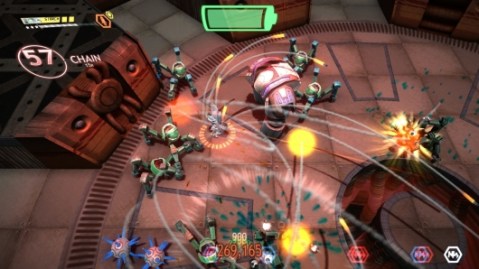
We’ve never really moved on from television of the smashiest variety, have we?
I am not, as a rule, one of the people for whom Greenlight is intended. This is because I enjoy cooking.
Cooking is delicate. Cooking takes time. Cooking is not particularly helped by having people clustered around eager to taste what you haven’t finished cooking yet. It’s not that I think the companies on Greenlight are wrong in some fashion, just that launching there means you’re buying a chance to taste something that the designers freely state isn’t yet cooked through. I’ll wait until you’ve finished with the cooking portion, thank you.
Assault Android Cactus is a Greenlight game, however, and one with a demo available. And it’s what I rolled, so it’s where I’m going. That having been said, what is present in the demo is quite polished and fun, although I harbor vague doubts about how much more you get at the moment for being an Early Access purchaser. But time enough for that elsewhere, let’s take a look at what the game actually is.
 Recent Work
- An error has occurred; the feed is probably down. Try again later.
Chocobo Dash
- An error has occurred; the feed is probably down. Try again later.
 Eliot Lefebvre