Challenge Accepted: Difficulty patterns

Giving the player ultimate control over the curve has both benefits and drawbacks, starting with the fact that players have the right to just opt out of much challenge there.
One of my favorite things to say about a game is that it has a difficulty curve bordering on a flat line. It’s a remarkably elegant way of pointing out that a game doesn’t really change its difficulty over time, that if you can clear the first level without too much trouble the next dozen won’t give you much more or less challenge. It’s not necessarily something that you want to be the case with a game, but it does happen.
It also presupposes that difficulty in most games is at least roughly a curve, but it can really be in lots of different shapes. If you want to get super technical, the shape can even vary from player to player, but that’s not the road I want to walk down today. No, today I want to take a look at how it works when you start tracking the challenge of a game over time, how the ebb and flow affects the game as a whole. Sure, we’ve played games where the curve resembles a flat line (or a vertical one), but even the idea of a difficulty curve means that there’s a different rate of change over time.
Challenge Accepted: Teaching patterns
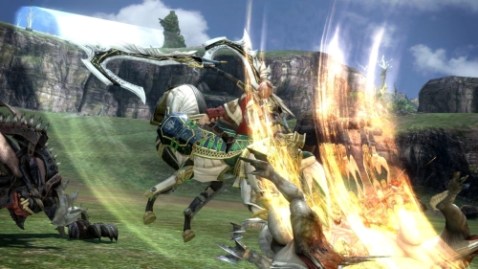
Yes, it takes a while, but you do get there eventually, and that’s part of the point.
From one perspective, there’s only one challenge in any given game, and that’s the last sequence. Every other portion is just there as training.
Obviously, the goal from a design standpoint is to have all of those intermediary challenges be just as fun. But they’re also there to train you for the final things, the real events, the big time. It’s the reason why games don’t start with the final boss fight, because you need to learn all of the elements that go into that fight. The first level in Super Mario Bros. introduces most of the major elements you’ll deal with through the game, and it does so in an environment wherein you can fairly easily learn how they work.
Every game is different, however, and there are lots of ways to teach players how to do things. So how do you teach players how to do the things they’ll have to do at the end of the game while still making the beginning of the game fun to play?
Challenge Accepted: Breaking out of the challenge box
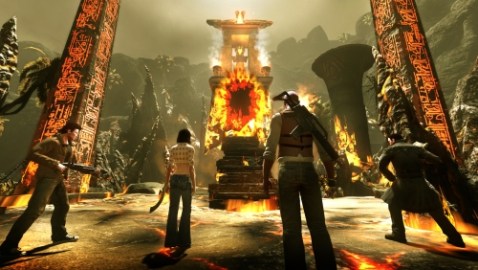
The game is substantially helped by its fair assortment of hellmouths in need of closing despite everything.
Playing The Secret World was in many ways both satisfying and infuriating. On the one hand, here’s an MMO that genuinely wanted its players to be engaged with puzzles beyond simply clicking on the right answer from a short and obvious list. That’s kind of awesome. On the other hand, the actual puzzles it had were highly reliant upon you scanning through fake websites, assembling clues very vaguely hidden in context, and then producing a synthesized answer. Or, as was far more often the case, looking up the solution online and skipping that whole tedious and unenjoyable aspect.
Still, there’s something to be said for the fact that the game did earnestly try to provide a challenge for its players that stretched beyond the norm. It was trying to challenge players beyond the usual sides of gameplay (which ties into that bit I outlined near the start of this feature) or simple common-knowledge trivia, asking players to flex a different skillset. They’re challenges that rely partly on things you’re not usually asked to do and partly upon the fact that you’re taught there’s a certain way video games play.
Challenge Accepted: The puzzle roadblock

Looked at in a broad enough sense, every game is a puzzle game, and the differences just come down to how it’s puzzling you.
I recently found myself playing through Half-Life 2 again for reasons that are not clear to me. But that’s not the important point right now; what’s more important is that I was struck, not for the first time, at how tedious stretches of the game could get. The tense, brutal firefights were great, but then suddenly I’m in Ravenholm and dealing with millions of small enemies nipping at my heels without any ammo to be found. Or I have to piece together another physics-based puzzle. Or I’m doing anything related to the game’s vehicles. Or the goddamn antlions and sand.
None of these are segments that are unfamiliar at this point. I know how to get through all of them with a minimum of fuss. But they wind up feeling tedious for various reasons, and every time I hit another one of these roadblocks I rolled my eyes in irritation. Which seems an apropos condition, because in some games, the puzzles evolve naturally from the existing gameplay, but in others they’re just a way of padding out the game until you get to the next good part.
Challenge Accepted: What makes a good challenge?
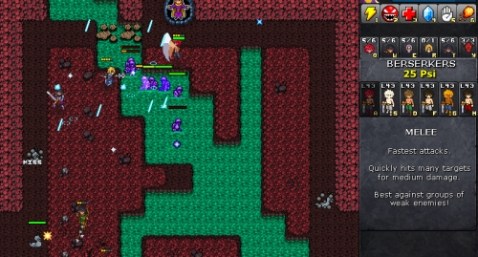
It’s not the fault of the level, it’s the fault of my own choices.
Good challenges are a little like pornography: when you see them, you know it.
Glib though that may be, the fact is that there’s no single formula that leads to a fair and enjoyable challenge every time. Heck, not too long ago I was talking specifically about challenges that work fine in one place but don’t work at all in another game or setting. So let’s be real and say that at best, you can put together the elements that should make for a good challenge whilst accepting that it might all fall apart under scrutiny.
Still, there are elements that point in the right direction. Perhaps it would be more fair to say that simply putting these things together won’t create a good challenge, but a good challenge will assemble all of these in a way that makes sense. Which brings us back to the same fundamental question in need of an answer. What makes for a good challenge?
 Recent Work
- An error has occurred; the feed is probably down. Try again later.
Chocobo Dash
- An error has occurred; the feed is probably down. Try again later.
 Eliot Lefebvre