Challenge Accepted: Do it yourself
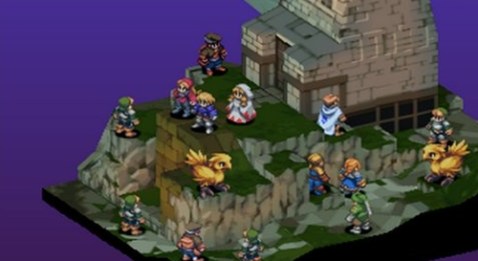
This is not an SCC, but it’s a nice shot.
Self-inflicted challenges and I have a long and lengthy relationship, due in no small part to my love of Final Fantasy Tactics. An idle conversation among fans started the Straight Character Challenge – a full group of characters, all the same class, making maximum use of the game’s mechanics and taking down every battle from start to finish. It took a long while, but every single class proved possible, albeit in many cases through abuse of the AI and odd little loopholes in the game’s coding.
I was never a super-active part of the community there, but I was active for a while, and I still admired the challenge a lot from the sidelines. The thing is that self-inflicted challenges both do and do not factor into a game’s difficulty. Sufficiently complex games lead to the creation of more such challenges, and they’re interesting, but they also don’t tie into the actual game at all. And, in some cases, they get co-opted by the developers for just that reason.
Challenge Accepted: Why fake difficulty is still a thing
Fakin’ it.
Fake difficulty isn’t a term of praise. Which is kind of obvious from the name, I know.
If you’re not well-versed in fake difficulty as a named concept, you’ll still know it when you see it. The mandatory stealth section when this game had not required any stealth gameplay before now. The camera angles that shift when you make a jump. The sudden mechanical shift into a whole new sort of game that you may not be any good at. A hunt for an object that would be easy to find… if not for the total lack of distinguishing marks from the background.
TVTropes does a good job listing the many, many flavors of fake difficulty, but it only briefly touches upon the fact that it’s not entirely bad. There are a few reasons it still shows up in games, though, and while some of them are bad, a couple of them are actually better than the alternative. So why is fake difficulty still a thing?
Challenge Accepted: Fair’s fair

It might seem fair to gang up on someone until you get ganged up on yourself.
If you think about it, the whole idea of challenge being fair is kind of strange at face value. Games build unfairness into themselves by design. If your average Mega Man game was fair, the boss would be able to pause the game and use weapons on me to target my weakness. The bosses start out by being unfair by design, at that; they can jump higher, run faster, fire more complex attacks, and so forth. That’s not fair.
Of course, if the boss fights were fair, the game would be kind of boring. Imagine a game where every boss dropped as easily as the player character. It’d be fair, but it wouldn’t be fun.
Fairness is a nebulous concept, but it’s also a really important one when you’re talking about games. We talk about the importance of it over and over, about the difference between games that are really hard to beat but fair compared to those that are just plain cheap. But how relevant is that, really? Are we looking for fairness, or are we just interested in accountability?
Challenge Accepted: Easy keeps you going
First time, yes, full challenge. Subsequent times? Thanks, I’ll just faceroll it on easy.
There are some people who are just not going to have fun with a game if it’s not a challenge. That’s a given, and it’s not a bad thing. It’s part of how games work, and it’s an important element to keep in mind. Games cannot be designed to be all easy, all of the time, or the developers would be saying that they didn’t want the money of a sizable chunk of audience members. And that would just be silly. We need to have challenges in games, things that are difficult to overcome, stuff that can’t be cleared in one or two quick moments of play.
But in the long run, it’s going to be the easy stuff that’s more beneficial for any game.
This sounds contradictory. After all, the people playing a game for the long haul, whether it’s single-player or multiplayer, are going to be the people with more practice. These are the people best suited to facing challenges, and more to the point these are the people who most likely want more challenge. How can easy content be more useful to a game on a whole than difficult things?
Challenge Accepted: What you’re wading into

If it were just this, it would admittedly be a little boring. it would also be consistent.
Can we talk about Frog Fractions? I want to talk about Frog Fractions.
If you haven’t played Frog Fractions, that’s easily rectified – it’s free right here. Aside from absurd humor, the developer’s stated goal for the game was to get back to a time before players knew everything about a game, to get back a sense of wonder and surprise when things keep changing on you as you play the game. It’s not really a spoiler to say that the basic version of the game that you start with isn’t what you end up playing when all is said and done (hint: the dragon can go down, too).
Don’t get me wrong, I think Frog Fractions is a great little piece of art. But as a pure game, it sort of comes down to a series of brain farts. It surprises you with its gameplay, yes, but that’s because it doesn’t deliver anything close to what it promised to on the tin, and the real challenge is figuring out what random direction to head in next. So how do you interpret the challenge in a game where the whole schtick is changing what you’re actually doing?
 Recent Work
- An error has occurred; the feed is probably down. Try again later.
Chocobo Dash
- An error has occurred; the feed is probably down. Try again later.
 Eliot Lefebvre