Should Bravely Default be a Final Fantasy game?

In most fantasy RPGs, having amnesia is like one better than having an iPod.
When is a duck not a duck? When is a Final Fantasy title not a Final Fantasy title? What does the former even mean these days?
There used to be a really clear distinction. Games were called Final Fantasy when they were part of a huge long series of games, each of which consisted of the same two words followed by a number. You can argue the point a little, sure – Mystic Quest exists, the first Seiken Densetsu game was marketed as a Final Fantasy gaiden – but by and large this was the abnormality. But now we’re deep into sequels and prequels and spinoffs that are, just the same, branded as part of Final Fantasy. The reason Final Fantasy Dimensions is called that instead of, well, Final Fantasy (previous installment +1) is pretty much arbitrary.
But it gets really weird with Bravely Default. Here’s a game that’s developed by a studio that has worked on Final Fantasy before. It’s a spiritual sequel to Final Fantasy: The 4 Heroes of Light, which itself is a spiritual sequel to Final Fantasy III‘s remake, which could almost be considered a sequel of sorts to Final Fantasy III due to the extensive nature of the remake. It obviously adheres pretty damn closely to the standard Final Fantasy tropes. I’ve seen people go so far as to say that in a just world, it would be a Final Fantasy title.
Should it be? That takes some talking. Read More…
We’re probably not facing another game crash

Not the face of the future.
In 1983, the video game industry crashed. Imploded might be a better term, honestly. A huge plethora of game consoles had popped up everywhere, and a lot of companies that had otherwise been getting invested in video games backed out. It was pretty extreme, something that most students of game history look back at with a certain degree of trepidation.
After all, it all collapsed once. It could all collapse again. Our hobby hangs on by the slimmest of threads, it seems, and all it would take is the slightest pressure for everything to come crashing down. It’s why you see articles about how the game industry is heading for another crash every few months, generally written by men and women who know quite a bit about how the industry works and has worked. The people who make games no longer have a passion for games or care about games, we’re past market saturation, the circumstances are all right. It’s going to happen again.
Except it hasn’t happened. The game industry has had hiccups, but we’re 31 years out from the last crash, and it seems likely that we’ll avoid hitting another one. For a few reasons. Read More…
Tolerance Levels
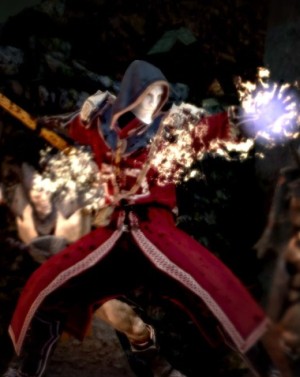
I would really have liked to include a screenshot of the upcoming DAII DLC, but we don’t know what that looks like yet, so have a mage in a Guy Fawkes mask.
In the beginning, the designers didn’t know what they had. Well, okay, they knew what they had: a game that you played with a computer. They just weren’t sure what to do with it.
Pong wasn’t really the first video game, nor was it the first one to answer the question of “how do we make money off of this?” It was just the first one to do so in a successful fashion. You fed the game a coin, you got to play. When one of the two sides reached a predetermined score, the match was over, and if you wanted to play again you had to feed the machine another quarter.
An Ode To Smart Bombs

This was randomly on the front page of Kongregate when I clicked over. (The game is D.N.8, if you’re curious.)
They’re called by many names, but they only really need one. They are smart bombs. And if it weren’t obvious that a largely video game-focused blog would be talking about video games, well, there you go. I don’t mean precision-guided munitions, I mean the life-saving smart bomb.
While every game has a lot of different elements going on in the background, the essence of the smart bomb remains constant. They’re limited-use items that when triggered will obliterate all nearby enemies and put a sizable dent in most bosses as well. You generally start with at least one use, and you can always replenish your uses during play. However, they are still limited, with the odds being that you won’t get more than a handful of uses in a given level at best. You need to hold out until you need one, or you’ll be fresh out when they’re truly useful.
I’m Ready, Sony Isn’t

“Lenny, you failed me.” “But Grandpa, Fairsley lied!” “Ah, shut up.”
Chris has an excellent post about what the new PS3 hack means for people who have any interest in playing games online on the console with something resembling a level playing field. Here’s the brief summary: sucks to be you.
It’s disappointing, but also unsurprising in a strange way. Sony’s entry in this generation of console interplay has been underwhelming, by which I mean that they have royally screwed themselves to the point where most companies would find a convenient scapegoat in upper management and start warming up the Sacrifice-o-Mat. To the best of my knowledge, this hasn’t happened yet, so I can only assume Sony has somehow managed to screw that up as well.
 Recent Work
- An error has occurred; the feed is probably down. Try again later.
Chocobo Dash
- An error has occurred; the feed is probably down. Try again later.
 Eliot Lefebvre