Demo Driver 8: Hard Reset
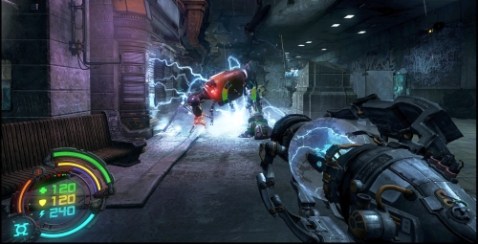
Robot rocked.
Let’s start this real simple-like: Hard Reset is what Serious Sam wanted to be.
I wasn’t too fond of Serious Sam, partly because my love of old-school FPS games is strongly tempered by the fact that I do not have a love of old-school FPS games. I acknowledge them, sure, and I had fun with Doom and Marathon back in the day, but that love faded fast and can now be found only in a handful of things here and there. But also because it was, well, kind of boring.
By contrast, Hard Reset‘s demo makes it very clear that it understands why these games worked and what parts were vital. It is by no means flawless, and it has things that others have pointed out as being kind of odd hiccups in the whole “relentlessly old-school FPS” layout, but it is clearly hitting the notes it wants to. Heck, I was enjoying it quite a bit, and I’m not even the target audience.
Telling Stories: The opening still matters
 Endings are the part of a story that tends to get the most press as being complicated, and with good cause. A bad ending makes you wonder why you wasted the time necessary to get to the ending, after all. It’s as true with roleplaying as anywhere else, which is why I’ve had more than a few columns on making satisfying endings in a medium of ongoing roleplaying where nothing ever really ends so much as it sort of concludes.
But what gets skipped over a lot is that the beginning matters, too. Maybe not as much as the conclusion, but in some ways it’s even harder to recover from a slipshod start. A poor ending makes people roll their eyes as they walk away, but a poor start leads to walk-offs before you even get the chance to end.
So how do you make the beginning memorable, concise, and enjoyable? How do you kick off a plot with all of the same panache you’d expect from a conclusion? I’m glad you hypothetically asked.
Anonymity isn’t the issue
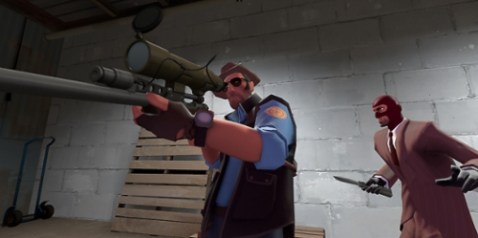
It’s not the fact that you don’t have to look at yourself that lets you get away with it.
After years of seeing comments on the Internet, I’m pretty sure that everyone’s conception of what causes asshole behaviors online is off the mark.
You cannot discuss people being jerks online without someone bringing up that damn Penny Arcade strip. Which is not a sociological paper, I know, but neither is this. Every discussion I’ve seen about people acting like dicks to others online is based around this assumption, that when you give a random person the option to be anonymous they instantly turn into a raging monster to whomever happens to be within spitting distance.
This is neglecting the many people who don’t do this, obviously. But it’s also ignoring the fact that we’re not anonymous on the internet, certainly not in the ways that this line of thinking suggests. We have our user names, we have our identities, we have ways that we’re marked. A five-minute stretch of Facebook makes it clear that anonymity isn’t what’s fueling the behaviors that we take as the price of doing business online. Or, more accurately, it is – just not in the configuration we think it is.
The Final Fantasy Project: Final Fantasy IV, part 12
Artwork from a sketch by Yoshitaka Amano
The game doesn’t really tell you where your destination will be for the final confrontation, but it seems pretty obvious from the sheer sparsity of options about where to go on the moon’s surface. A quick trip to the Crystal Palace allows the party to walk into the back and access the space beneath the moon’s surface, complete with the power of the crystals guiding everyone or whatever. One suspects that the game was getting a bit bloated by this point.
The Lunar Subterrane is big and sprawling, but not quite so much as the last boss rush in Final Fantasy III; you can actually exit, for one thing, which right away makes the experience very different and gives you more reliable control over the encounters you’re facing. More to the point, you can save before the final boss rather than simply praying for rain. It’s not the apex of the sprawling final dungeons that would become a regular series thing later in the franchise, but this one is big and meant to be tackled in stages.
Hard Project: Robotech

So maybe it’s mostly because I haven’t done a column on enormous robots in a while, what’s the difference?
Harmony Gold, at this point, is a spite house that happens to be incorporated. And pretty much all of its spite is directed toward the license that it’s sitting on for the original Macross, which ties into its pet property of Robotech, which is used for nothing. Because wow, that thing is a mess.
The short (and glossing/inaccurate) version is that back in the 80s, Harmony Gold had gotten its hands on some anime that it wanted to syndicate. Unfortunately, syndication rules required 65 episodes to exist before a series could be distributed, and the three series in question (Macross, Genesis Climber MOSPEADA, and Super Dimension Cavalry Southern Cross) didn’t individually hit that mark. So Carl Macek’s job was to sit down and stitch these three separate shows with different characters, premises, and setting into a single continuity. The result was Robotech, which subsequently had more material produced, making it a distinct entity from any of its predecessors.
As fascinating as that whole nonsense is to talk about – and it really is, right down to lots of polarized reactions that never approach the subject of whether or not the new series is any good – that’s not what I’m here to discuss. Because while Harmony Gold is busy not actually making more Robotech material, a video game seems like an easy way to extend the license. Yet at the same time, making one is really hard to do.
 Recent Work
- An error has occurred; the feed is probably down. Try again later.
Chocobo Dash
- An error has occurred; the feed is probably down. Try again later.
 Eliot Lefebvre