Demo Driver 8: MXGP – The Official Motocross Videogame

Between the helmets and the posture, I can’t help but get the sense that the riders of these bikes are sort of confused by what’s happening. “Heavens, this bike is now airborne! I have made a grave error, whatever shall I do?”
You know, I’ve gotten several demos where I’ve had nearly the same complaints about different games, but this is the third vaguely-European hyper-simulationist sports title I’ve played now. The first was early in this feature, when I took on RACE 07 and found it lacking in pretty much everything I would want in a racing game. The second was Don Bradman Cricket 14, which may very well have had everything I want in a cricket game, I don’t know. It runs slightly afoul of the fact that I don’t really want a cricket game at all, but still.
And here we are again with MXGP – The Official Motocross Videogame, which seems to be much like RACE 07 except that now I’m playing a man on a little bike instead of a man in a car. I guess that the whole simulation of sports thing is a fairly big field for developers there, since this is now officially a trend. If you’re expecting to have a game in which you have fine control over your bike, the movement thereof, and your rider, well, here you go.
Challenge Accepted: The puzzle roadblock

Looked at in a broad enough sense, every game is a puzzle game, and the differences just come down to how it’s puzzling you.
I recently found myself playing through Half-Life 2 again for reasons that are not clear to me. But that’s not the important point right now; what’s more important is that I was struck, not for the first time, at how tedious stretches of the game could get. The tense, brutal firefights were great, but then suddenly I’m in Ravenholm and dealing with millions of small enemies nipping at my heels without any ammo to be found. Or I have to piece together another physics-based puzzle. Or I’m doing anything related to the game’s vehicles. Or the goddamn antlions and sand.
None of these are segments that are unfamiliar at this point. I know how to get through all of them with a minimum of fuss. But they wind up feeling tedious for various reasons, and every time I hit another one of these roadblocks I rolled my eyes in irritation. Which seems an apropos condition, because in some games, the puzzles evolve naturally from the existing gameplay, but in others they’re just a way of padding out the game until you get to the next good part.
The Final Fantasy Project: Final Fantasy IV, part 11
Artwork from a sketch by Yoshitaka Amano
The Lunar Whale is clearly the spiritual equal to the Invincible from Final Fantasy III; there’s an onboard Fat Chocobo, a free inn, all of that fun stuff. But more importantly, it’s our ticket to the moon! We’re on the moon! Yay!
What were we going to do on the moon again? I mean, I know Golbez wanted to get to the moon, but do we know why he wanted to get to the moon or what he planned on doing once he arrived on the moon?
Leaving aside that I’m pretty sure an angry fight broke out on the Lunar Whale as someone asked that question, there’s a store up here that sells Elixirs and Ethers, and there’s a big crystalline palace just sitting there that seems like the place to visit. So we find a place to park the Whale, get out, and head into a castle just outside of it. With only the slightest bit of concern, at that. I mean… I remember what happened the last time I entered a cave near an otherwise isolated tower of crystal. It wasn’t necessarily a fun ride. Stupid Cloud of Darkness.
Demo Driver 8: Splice

On the one hand, I appreciate that we have arrived at a point wherein a game that would not do well with any plot doesn’t feel the need to engage in even an excuse plot. On the other hand, I’m annoyed that a game can’t be bothered to even give me an excuse plot, so perhaps I’m just messed up.
When I was younger, I had a book report to write about a book that I didn’t particularly care about. The one trick I hat was, well, an array of literary tricks. So I used them. I dove into my big bag of stylistic obfuscation and went nuts, dropping every bit of didactic deception into the requirements as I could. By the end, I had four pages or so of book report consisting of a paragraph of information and a whole lot of flourish.
My teacher gave it back to me with a note that I had written something which served as the ultimate triumph of style over substance. I think Splice would have given it a run for its money, though.
Splice, by the broadest definition, is a puzzle game. By a more practical definition, it’s really a game of stylistic clicking that doesn’t mar the experience with things so superfluous as narrative or feelings or even meaning. It’s a bit of distracted clicking. But it’s very pretty and soothing clicking, which is probably worth something, even so.
Horrific asides
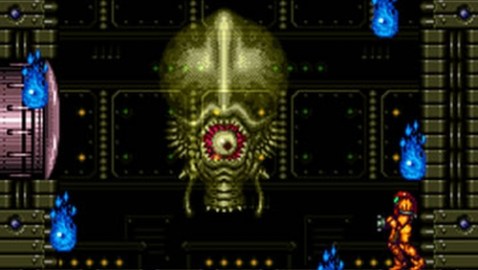
You wouldn’t think this would even register as scary in a game where you fight a space dragon in a world of lava, but here we are.
I loved the Wrecked Ship in Super Metroid. Honestly, I loved the whole game, so in many ways that’s not terribly interesting, but the Wrecked Ship in particular stood out in my mind. Yes, it was clearly a part of Zebes, but it was also this strange interloper, an alien element unconnected to the larger plot. I remember exploring it before it was powered on, then again after it had regained its power, at once intrigued and confused as to its ultimate purpose.
Super Metroid, of course, is not a horror game. But it’s also not the only game that makes use of horrific asides.
A horrific aside is a segment in an otherwise non-horror game that inserts a few elements of horror into play, whether you were or weren’t expecting it. When done right, it breaks up the flow of the game without being jarring, giving a sense that the player is more vulnerable than previously thought, mixing in shades of fear without making the whole game an exercise in terror. Sometimes, it’s even more scary and memorable than when the whole game is focused around the horror.
 Recent Work
- An error has occurred; the feed is probably down. Try again later.
Chocobo Dash
- An error has occurred; the feed is probably down. Try again later.
 Eliot Lefebvre