Demo Driver 8: The Stanley Parable Demonstration

Please do not read the alt text for this image.
It’s hard to talk about The Stanley Parable without sounding like you’re a pretentious twit who uses the word “metatextual” far more often than is healthy. (The FDA recommends using it no more than twice per 1000 words.) And The Stanley Parable Demonstration is even a layer beyond that. It’s not so much a demo as it is a metatextual examination of game demos, layered on top of a game that is itself an examination of choice and the illusion of agency of games. So it’s at once trying to convince you to buy a game based on nothing from the actual game, and it’s also trying to point out the futility of trying to demonstrate a game in that fashion.
While it may come as something of a surprise based on all of that, it’s actually fairly effective at giving you an idea of what you’re going to be getting into. It presents its questions, gets you to ask some questions of your own, and the whole thing plays out with just the right mixture of not actually being a game adjacent with just enough player agency. Even if it’s mostly an illusion.
The Final Fantasy Project: Final Fantasy III, part 10

Artwork from a sketch by Yoshitaka Amano
It’s kind of a shame that this game hasn’t made as big of a deal about Xande as the root of all evil. Sure, he’s the guy behind a whole lot of crap that we’ve dealt with up to this point, but we haven’t seen him or even heard from him directly. Yes, I know, up until we reached the surface world he was kind of frozen in a flooded landscape, but still. It would have been nice to put a face to the name before now, you know? There’s no sense of an emotional grudge match.
Of course, Final Fantasy II tried doing that, and that had its own problems.
At any rate, the last “dungeon” in Final Fantasy III is pretty ornate, composed of four separate dungeons, albeit with one of them as an optional sidequest. Once you’ve broken through the guardian statues with the four Fangs, you’ve got the chance to see the start, but you need those keys from Unei and Doga to really get into the meat of the dungeon. So off we go, back to the spot where we unlocked the final set of jobs, ready to crush the face of whoever stands between us and our goal.
Demo Driver 8: Ring Runner: Flight of the Sages (#206)

It’d be really nice if some of these games provided better screenshots instead of looking like a hot mess in still frames.
Let’s hear it for the crazy ambitious indie game.
I’m not talking about indie games that come down to “examining a new idea,” that’s just a thing. No, I’m talking about indie titles that see a big idea and just go for it, ones that say things like “let’s mash together space exploration, sim flight elements, and RPG gameplay into a single space.” I’m talking about games that bite off way more than they can chew or even fit in their mouth at once.
Ring Runner: Flight of the Sages definitely falls under that header. It is, in many ways, a mess – but it’s a mess because it’s pulling in a bunch of disconnected genres and doing the best it can to try and make all of them work together. I shan’t scorn it for the parts where it falls down, because I love how enthusiastically it tries. There are a lot of games all going on at the same time here, and while I’ll be the first to say that it doesn’t seem to quite congeal, boy does it ever try hard. Which is pretty keen.
Challenge Accepted: Do it yourself
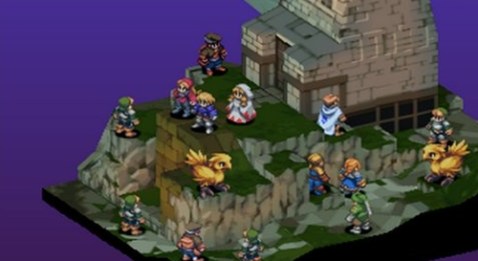
This is not an SCC, but it’s a nice shot.
Self-inflicted challenges and I have a long and lengthy relationship, due in no small part to my love of Final Fantasy Tactics. An idle conversation among fans started the Straight Character Challenge – a full group of characters, all the same class, making maximum use of the game’s mechanics and taking down every battle from start to finish. It took a long while, but every single class proved possible, albeit in many cases through abuse of the AI and odd little loopholes in the game’s coding.
I was never a super-active part of the community there, but I was active for a while, and I still admired the challenge a lot from the sidelines. The thing is that self-inflicted challenges both do and do not factor into a game’s difficulty. Sufficiently complex games lead to the creation of more such challenges, and they’re interesting, but they also don’t tie into the actual game at all. And, in some cases, they get co-opted by the developers for just that reason.
The Final Fantasy Project: Final Fantasy III, part 9
Artwork from a sketch by Yoshitaka Amano
If you take nothing away from this series of columns, aside from the fact that I really enjoy this game, let it be this: the remake does a whole lot of things that aren’t to its credit. The last set of jobs is this in a microcosm.
See, in the original version of Final Fantasy III, the jobs were not anything remotely approaching balanced. Vikings were completely forgettable, for example, having nothing to recommend them aside from HP and some weapons that weren’t needed. Scholars were a joke. And everything in the game was outclassed by the last two jobs you got, which didn’t become available until the last dungeon of the game was well underway.
When Matrix Software remade the game, they really wanted to ensure that all of the jobs had some purpose. Certainly, the remake succeeds in making some of them far more viable – I just listed a couple of them, but even Geomancers, Bards, and Rangers became more viable with the remake. But the last set of jobs now includes Ninja and Sage, and it kind of makes a mess out of things. The efforts to “balance” these jobs ultimately just make the last set less interesting.
 Recent Work
- An error has occurred; the feed is probably down. Try again later.
Chocobo Dash
- An error has occurred; the feed is probably down. Try again later.
 Eliot Lefebvre