Demo Driver 8: Gunpoint
The Real Folk Blues.
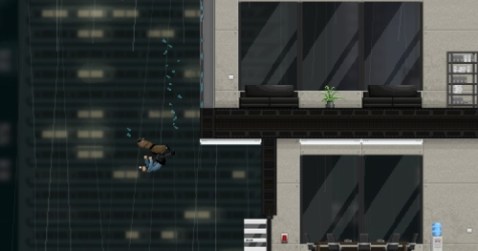
Gunpoint is probably closer to a stealth game than a puzzle game, because it reminds me a lot of Mark of the Ninja. Despite the fact that it really doesn’t play like Mark of the Ninja at all.
According to its store page, Gunpoint is a stealth puzzler, but the emphasis is more on the former than the latter. I say this because stealth games are by definition puzzle games; you’re trying to figure out how to get from point A to point B without being caught, shot, or otherwise stopped. What makes for a particularly good stealth game is when the game gives you various tools to accomplish those central objectives, allowing you to go through the stages however you want.
It’s rare for a game to explicitly give you more puzzle-like control over the stage configuration, though, which makes up Gunpoint‘s central gimmick. And it’s a gimmick that works well, no more or less realistic than Watch_Dogs allowing you to hack everything with bizarre results but far more subtle and well-paced in how it plays out. Like Mark of the Ninja, you are a predator in the shadows, but instead of lurking in corners and executing elegant maneuvers, you’re a ghost in the machine.
A story of the vagrant

You could be forgiven for thinking that this game’s plot intimately involved both of these characters with one another.
Whenever I start writing anything about Vagrant Story, I have to force myself not to start gushing about the elegant perfection of the weapon system. I mean, it’s simple – six monster families, using a weapon on one builds up bonuses against that monster type, and your goal becomes stacking up that bonus while you reforge that weapon into more potent forms over time. But then you consider that weapons have different damage properties, and you want to try and build a weapon using properties that most monsters of that family will be weak against, and then whoo, I’m down the hole again and I wake up to find I’ve ranted about the system for hours.
It’s a simple, elegant, brilliant design. So much of the game is a simple, elegant, brilliant design. On one hand, it’s almost criminal that the game has never received any kind of sequel, even any sort of larger story resolution beyond getting retroactively thrown into the overall Ivalice continuity (although Yasumi Matsuno has gone back and forth on that one). But on the other thand, it’s kind of a good thing. It somehow makes the game work better that it never became iterative, that all of it is contained solely herein, even if you wish there was more.
The Final Fantasy Project: Final Fantasy IV: The After Years, part 3
Artwork from a sketch by Yoshitaka Amano
Once you’ve cleared the first of the tales, the game opens up a bit – there are six more tales available right away, each covering a different character who ties back into Final Fantasy IV. Curiously, Ceodore is the only new party member to get billed as having his own tale, as all of the others feature characters from the first game, although Rydia, Palom, and Porom have all grown up quite a bit since their initial appearances.
And yes, there are more than seven altogether, but the point is that these events happen in a similar timeframe and don’t overlap with other characters in the same way that Ceodore’s tale does. But let’s put that to one side for a moment; we’re still going to take these on in the order they’re presented and the order of their release. I did think it was neat that the option for skipping between them existed, though, especially knowing that more unlock as you continue.
The Final Fantasy Project: Final Fantasy IV: The After Years, part 2
Artwork from a sketch by Yoshitaka Amano
As much as it surprises me to say so – and it does surprise me quite a bit, let me tell you – I’ve been enjoying The After Years up to this point. Sure, Ceodore’s only got the thinnest sketch of character motivation, but he’s not exactly alone in this fact, and the general feel is of events cascading quickly out of control while at the same time not feeling forced. He’s lost a lot, possibly everything, but he still has the will to push through.
Of course, will doesn’t make monsters not attack you, and not too long after his dying order from his commander, he’s being accosted by beasts. The first two are barely even relevant, but the third one has him on the ropes until someone mysteriously jumps into battle. Someone with narrow features and a portrait that makes strong eye contact. Someone with long blonde hair and a penchant for appearing dramatically. Someone who is referred to as only “the Hooded Man,” despite the fact that his identity is immediately obvious to anyone familiar with the original game.
Do we have to pretend we don’t know him? We… we do, don’t we.
Hard Project: Sonic the Hedgehog

When a series resorts to mining out its past, it’s usually because the present is much less interesting.
This may come as a shock to some of our younger readers, and for that I apologize. But you know all of that terrible art on DeviantArt that involves cartoon hedgehogs submitting to Jesus and usually leads directly into some mind-scarring pornography? That’s all based on a series of video games! A series of video games that were originally based around a little blue hedgehog that ran really quickly. You have to understand that the 90s were a different time. (We don’t understand how the porn and the Jesus thing happened, though.)
As funny as that might seem at a glance, the fact of the matter remains that the weird fan culture has become the most relevant part of the Sonic the Hedgehog franchise in recent years. Kind of understandably so, even. The franchise has been showing cracks ever since the Dreamcast days, and the current state of affairs is lamentable but hardly unexpected. At this point, making a new game is quite possibly not a good idea, and it’s definitely a hard project.
 Recent Work
- An error has occurred; the feed is probably down. Try again later.
Chocobo Dash
- An error has occurred; the feed is probably down. Try again later.
 Eliot Lefebvre