Telling Stories: The opening still matters
 Endings are the part of a story that tends to get the most press as being complicated, and with good cause. A bad ending makes you wonder why you wasted the time necessary to get to the ending, after all. It’s as true with roleplaying as anywhere else, which is why I’ve had more than a few columns on making satisfying endings in a medium of ongoing roleplaying where nothing ever really ends so much as it sort of concludes.
But what gets skipped over a lot is that the beginning matters, too. Maybe not as much as the conclusion, but in some ways it’s even harder to recover from a slipshod start. A poor ending makes people roll their eyes as they walk away, but a poor start leads to walk-offs before you even get the chance to end.
So how do you make the beginning memorable, concise, and enjoyable? How do you kick off a plot with all of the same panache you’d expect from a conclusion? I’m glad you hypothetically asked.
The Final Fantasy Project: Final Fantasy IV, part 12
Artwork from a sketch by Yoshitaka Amano
The game doesn’t really tell you where your destination will be for the final confrontation, but it seems pretty obvious from the sheer sparsity of options about where to go on the moon’s surface. A quick trip to the Crystal Palace allows the party to walk into the back and access the space beneath the moon’s surface, complete with the power of the crystals guiding everyone or whatever. One suspects that the game was getting a bit bloated by this point.
The Lunar Subterrane is big and sprawling, but not quite so much as the last boss rush in Final Fantasy III; you can actually exit, for one thing, which right away makes the experience very different and gives you more reliable control over the encounters you’re facing. More to the point, you can save before the final boss rather than simply praying for rain. It’s not the apex of the sprawling final dungeons that would become a regular series thing later in the franchise, but this one is big and meant to be tackled in stages.
Hard Project: Robotech

So maybe it’s mostly because I haven’t done a column on enormous robots in a while, what’s the difference?
Harmony Gold, at this point, is a spite house that happens to be incorporated. And pretty much all of its spite is directed toward the license that it’s sitting on for the original Macross, which ties into its pet property of Robotech, which is used for nothing. Because wow, that thing is a mess.
The short (and glossing/inaccurate) version is that back in the 80s, Harmony Gold had gotten its hands on some anime that it wanted to syndicate. Unfortunately, syndication rules required 65 episodes to exist before a series could be distributed, and the three series in question (Macross, Genesis Climber MOSPEADA, and Super Dimension Cavalry Southern Cross) didn’t individually hit that mark. So Carl Macek’s job was to sit down and stitch these three separate shows with different characters, premises, and setting into a single continuity. The result was Robotech, which subsequently had more material produced, making it a distinct entity from any of its predecessors.
As fascinating as that whole nonsense is to talk about – and it really is, right down to lots of polarized reactions that never approach the subject of whether or not the new series is any good – that’s not what I’m here to discuss. Because while Harmony Gold is busy not actually making more Robotech material, a video game seems like an easy way to extend the license. Yet at the same time, making one is really hard to do.
The Final Fantasy Project: Final Fantasy IV, part 11
Artwork from a sketch by Yoshitaka Amano
The Lunar Whale is clearly the spiritual equal to the Invincible from Final Fantasy III; there’s an onboard Fat Chocobo, a free inn, all of that fun stuff. But more importantly, it’s our ticket to the moon! We’re on the moon! Yay!
What were we going to do on the moon again? I mean, I know Golbez wanted to get to the moon, but do we know why he wanted to get to the moon or what he planned on doing once he arrived on the moon?
Leaving aside that I’m pretty sure an angry fight broke out on the Lunar Whale as someone asked that question, there’s a store up here that sells Elixirs and Ethers, and there’s a big crystalline palace just sitting there that seems like the place to visit. So we find a place to park the Whale, get out, and head into a castle just outside of it. With only the slightest bit of concern, at that. I mean… I remember what happened the last time I entered a cave near an otherwise isolated tower of crystal. It wasn’t necessarily a fun ride. Stupid Cloud of Darkness.
Horrific asides
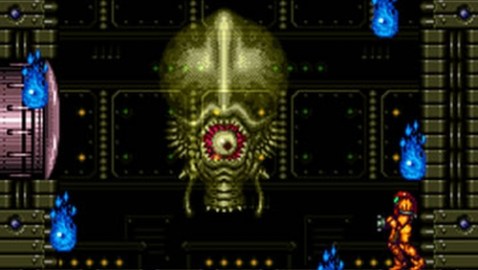
You wouldn’t think this would even register as scary in a game where you fight a space dragon in a world of lava, but here we are.
I loved the Wrecked Ship in Super Metroid. Honestly, I loved the whole game, so in many ways that’s not terribly interesting, but the Wrecked Ship in particular stood out in my mind. Yes, it was clearly a part of Zebes, but it was also this strange interloper, an alien element unconnected to the larger plot. I remember exploring it before it was powered on, then again after it had regained its power, at once intrigued and confused as to its ultimate purpose.
Super Metroid, of course, is not a horror game. But it’s also not the only game that makes use of horrific asides.
A horrific aside is a segment in an otherwise non-horror game that inserts a few elements of horror into play, whether you were or weren’t expecting it. When done right, it breaks up the flow of the game without being jarring, giving a sense that the player is more vulnerable than previously thought, mixing in shades of fear without making the whole game an exercise in terror. Sometimes, it’s even more scary and memorable than when the whole game is focused around the horror.
 Recent Work
- An error has occurred; the feed is probably down. Try again later.
Chocobo Dash
- An error has occurred; the feed is probably down. Try again later.
 Eliot Lefebvre