Hard Project: The Matrix

How could this have gone wrong? Oh, wait, all the ways.
The Matrix is one of those things that was a very big deal when it came out and then faded in importance about five minutes later. It’s been a decade since the last film, and the odds of us seeing another one are slim to none. Which is a shame, because it’s still a franchise I like quite a bit, even if I’d like it more if we had gotten the prequel-and-sequel the Wachowskis had originally wanted instead of the single sequel split into two parts.
If you like pretending the two sequels didn’t happen, imagine them as one lean two-hour film and start falling in love again.
We’ve seen three games based on the franchise, with one of them (The Matrix Online) both failing to live up to the promise of that concept and completely failing to deliver on what was originally conceived of in a persistent universe. It kind of makes sense, if you think about it. Even though the movies look great and prompt lots of thoughts vis-a-vis “man, it’d be great to play this as a game,” the whole thing winds up being a really hard project from the word go.
Demo Driver 8: Wings of Vi
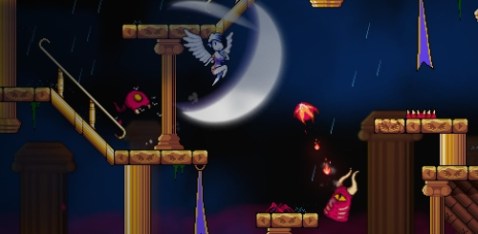
She looks so mildly out-of-sorts all the while.
I’m not sure if satisfaction or frustration dominated my playtime with Wings of Vi. I’m not sure if I would want to play it again or not. But I will say that the question isn’t as open-and-shut as I would have guessed from its description, so it gets points for that.
Much like last week’s entry, Wings of Vi is aiming at being a retro-style platformer, right down to evoking the feeling of brutality that you would get from 16-bit games at times. As soon as I read that, images of platform hell and the sheer constant roadshow of everything everywhere trying to kill you danced into my head. Add to that a buxom and rather lackadaisically dressed protagonist, and I was not hopeful.
Fortunately for my continued sanity, the game is most definitely not an entry into platform hell, despite the fact that its narrative concerns warring against a very literal hell. Which alone gives me hope, because while the game aims at being hard – and one could argue about “too hard” here and there – it does so in a much more imaginative manner.
Telling Stories: Smothering words
 The key to communication is brevity. The shortest form of a sentence that conveys all needed information is the best one.
Anyone who has read my words over the majority of my life will know that I am not exactly shy about using plenty of words, obviously, but that doesn’t mean that more words are automatically better. Your choice of words and how many you use contribute to how a piece of text is meant to be read. Something that gets lost very frequently in roleplaying, where players type out lengthy and ornate descriptions of something as simple as picking up a glass.
I don’t care how interesting you’re sure that single act of glass-lifting was, it’s not worth that much time or effort. It’s a glass. You lift it and drink from it. And if you spend too much time typing out how your character does every little thing, you waste a lot of time not being concerned over what your character is actually doing.
Challenge Accepted: Perfect play

You could, in theory, program a Dan AI so perfect that no human player could touch him.
Here’s the problem with AI opponents: when programmed to win, they will win against humans 100% of the time in contests of skill.
I’ve mentioned before that there are four main avenues of challenge in games, but the computer easily bests humans in three of them by definition. A properly programmed opponent who wants to win has better reflexes than you could hope to have, since there are no manual dexterity challenges involved. There’s no problem of managing teammates or of remembering what’s in the game. There isn’t even much space for thought as an avenue of winning; it’s just possible to be smarter than the programmer and find avenues they didn’t consider.
AI opponents in basically every game are not tuned for perfect play, though. Even the hardest opponents need to give players a chance to win, after all. Perfect play is the flipside of having games be a series of decisions with some serving as better decisions than others, the idea of making all of the right decisions and having the dexterity needed to execute those choices properly and reliably. And it’s helpful to consider perfect play in the larger framework of games and challenges, and how much of it is, in fact, contextual.
The Final Fantasy Project: Final Fantasy V, part 1
Artwork from a sketch by Yoshitaka Amano
If you remember back to last August when I first started talking about Final Fantasy IV, you might remember that I also started talking about Final Fantasy V. Or at least I mentioned that it was a thing, because as much as people like to claim that Final Fantasy IV got toned down because Square believed American gamers were stupid, that’s not what happened But it is what happened to Final Fantasy V.
Of course, Final Fantasy V doesn’t have the allure of Final Fantasy III as forbidden fruit, since it was the first of the three unreleased games to make the official jump to North American shores. Ironically, this took place long before its obvious inspiration came out here. Final Fantasy V is a pretty direct spiritual sequel to Final Fantasy III, you see, in both terms of story and mechanics. It’s also a game that kind of relies on a knowledge that Square was pretty certain most players just didn’t have, which wound up killing translation on the vine and led to a completely different game.
 Recent Work
- An error has occurred; the feed is probably down. Try again later.
Chocobo Dash
- An error has occurred; the feed is probably down. Try again later.
 Eliot Lefebvre