Hard Project: Silent Hill

The hills are alive with mist monsters and nurses.
I have a deep love of Silent Hill. Part of this is due to being from New England; sleepy little resort towns being drowned by mists are less “unexpected horror” and more “standard window dressing” around here. I am fairly certain I’ve driven through towns that could fit the description of the eponymous town with one or two details changed.
But that’s not the heart of the reasons, obviously; what I really love about the series is its slow, grinding, oppressive psychological horror. It’s that sense of wrenching and grinding awfulness, the idea that you’re trapped in a town that is actively malevolent, wearing down your defenses and your sense of boundaries until you no longer know what you’re trying to do. The whole thing just wears at you, player and character alike, leaving you with the slow rolling burn that’s so valuable in horror.
Unfortunately, the series has been faltering in recent years. Silent Hill 4 started a downward trend, and of the four subsequent installments the only one that’s received fairly strong praise is the remake of the first Silent Hill. So why is this horror franchise so difficult to keep alive, especially when it’s got some of the strongest horror games ever as a foundation?
Demo Driver 8: Din’s Curse (#273)
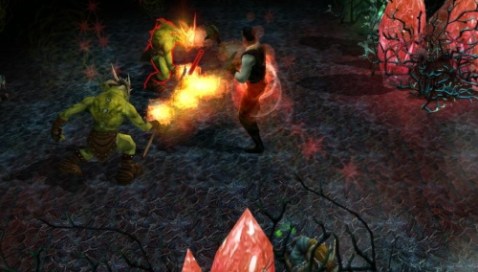
Go kill the things down the hole, you jerk.
Sometimes a game’s biggest problem isn’t itself, it’s the market. Which is really sad when just a few years earlier, you could have really been a contender.
Din’s Curse is a game very much in a familiar vein, plumbing the depths of the graphical roguelike that Diablo plumbed first oh so many years ago. Just from that description alone you have an image in your head, I’m sure, and I’m going to tell you right now that it’s largely accurate. Beyond that, though, it also does a good job of putting its own spin on exactly how class mechanics and the like work, and it was released at a time when the genre hadn’t experienced a big resurgence.
However, right now it’s in a field with Diablo III and Path of Exile and Torchlight II and Marvel Heroes and so on. The net result is that a game which could have been a real charmer is placed up against a number of competitors that it just can’t, well, compete against. Not solely by virtue of quality, but because its weaknesses show through.
Telling Stories: A little special goes a long way
 You want your characters to be special. That’s fine, that’s understandable, that’s even commendable. So you make your first character a half-dragon spawn of the realm of faeries, and…
Well, no. No, we’re already clocking out, and no, it’s not just because you’re doing so in a game with neither dragons nor faeries. It’s because your character is too special. Your character has broken the Specialometer. It’s impossible to relate to them any longer, they’re just too special for us to properly internalize what their deal is.
So let’s talk about people who are special in small ways. About picking out one or two obvious things that aren’t common and then building a character around that rather than trying to be The Most Unique Snowflake Ever. Because wouldn’t you know it, being less special can actually make your character feel more special in the long run than being a half-dragon faerie spawn. Unless you’re playing a superhero game, maybe, but even then.
Challenge Accepted: What you’re wading into

If it were just this, it would admittedly be a little boring. it would also be consistent.
Can we talk about Frog Fractions? I want to talk about Frog Fractions.
If you haven’t played Frog Fractions, that’s easily rectified – it’s free right here. Aside from absurd humor, the developer’s stated goal for the game was to get back to a time before players knew everything about a game, to get back a sense of wonder and surprise when things keep changing on you as you play the game. It’s not really a spoiler to say that the basic version of the game that you start with isn’t what you end up playing when all is said and done (hint: the dragon can go down, too).
Don’t get me wrong, I think Frog Fractions is a great little piece of art. But as a pure game, it sort of comes down to a series of brain farts. It surprises you with its gameplay, yes, but that’s because it doesn’t deliver anything close to what it promised to on the tin, and the real challenge is figuring out what random direction to head in next. So how do you interpret the challenge in a game where the whole schtick is changing what you’re actually doing?
The Final Fantasy Project: Final Fantasy III, part 1

Artwork from a sketch by Yoshitaka Amano
Final Fantasy III is why this project is what it is.
We’re now entirely out of the realm of repeats from stuff I’ve written before; everything going down in these columns is totally live, so I’m not yet sure how long we’ll be exploring the world of whatever-planet-this-game-takes-place-upon. But we’re doing so on the note of exploring a game that had, easily, the most convoluted trip across the waters of any title in the Final Fantasy franchise. Which is a little weird when you consider that it more or less finished the foundational work started by Final Fantasy and Final Fantasy II.
See, Final Fantasy III never came out in America. Sure, Final Fantasy II took a long time to come over in the form of Final Fantasy Origins, but that version of the game was a strict graphical update and the mechanics were identical. The original form of Final Fantasy III, however, has never been released – and at this point, odds are low that it ever will be, because the remake sort of has two sequels and is the general port of call. I told you this was convoluted.
 Recent Work
- An error has occurred; the feed is probably down. Try again later.
Chocobo Dash
- An error has occurred; the feed is probably down. Try again later.
 Eliot Lefebvre